Hanoi’s food markets are not simply places to buy something quickly. They are working neighbourhoods, social meeting points, and some of the easiest places to see how the city eats after dark. A market visit might begin with fruit and herbs, continue with a bowl of noodles, and finish with a sweet drink while scooters thread around the edge of the crowd.
This guide to the best food markets in Hanoi is designed for travellers who want more than a checklist. It explains what each kind of market is good for, how to plan an evening, what to eat, and how to stay comfortable without turning the experience into a rushed food challenge. For the wider street-food context, pair it with our guide to enjoying Hanoi street food like a local.
What makes Hanoi’s food markets worth visiting?
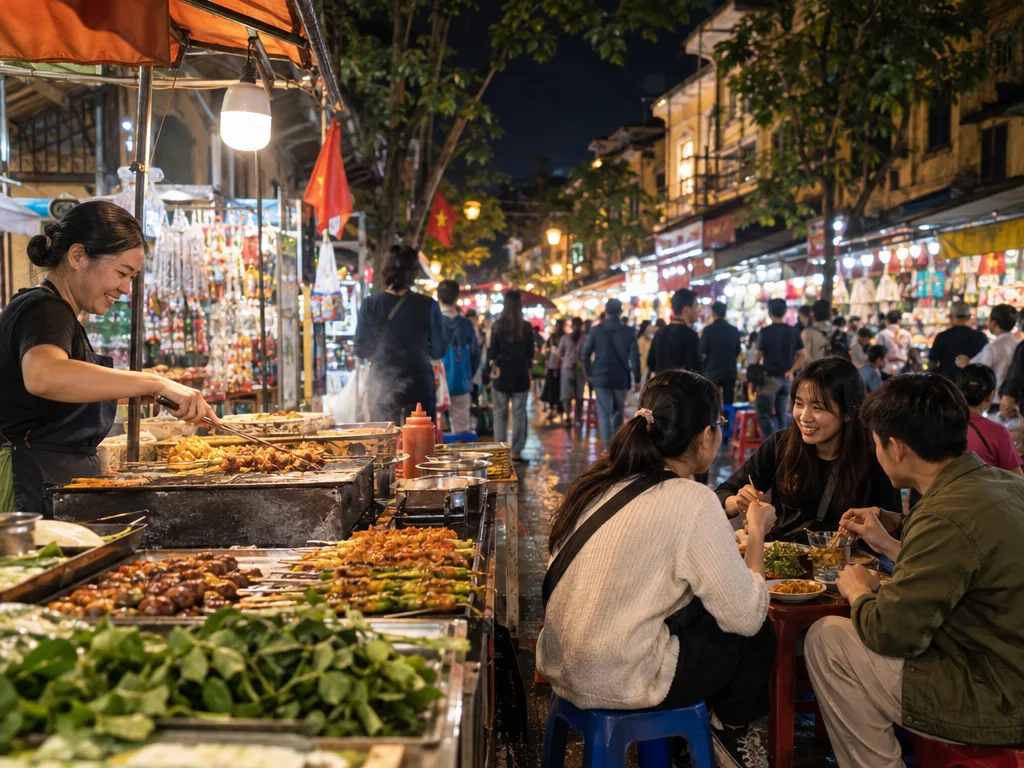
Hanoi’s markets work on several levels at once. In the daytime, a traditional market may be a practical source of vegetables, tofu, seafood, flowers, spices, and household goods. In the evening, selected streets and market areas become more atmospheric: vendors serve small portions, families browse together, and visitors can move from one stall to the next without committing to a formal restaurant.
The appeal is variety. One stall may specialise in grilled meat, another in noodles, another in fresh fruit or a warm dessert. Portions are often easier to share, so a market can suit a couple or a small group that wants to taste broadly. It is also a useful setting for understanding the relationship between Hanoi’s food and its streets: stools face the pavement, ingredients are prepared in view, and the meal is shaped by the rhythm of the neighbourhood.
Do not expect every market to be a permanent food court. Some are primarily produce markets and only have a small food section. Others are busiest on particular evenings or during a walking-street programme. Treat the market as a living place rather than a fixed attraction, and your expectations will match the experience.
The best food markets in Hanoi for different kinds of visitors
Dong Xuan and the northern Old Quarter
Dong Xuan is a useful starting point for travellers staying around the Old Quarter because it connects market life with a dense historic neighbourhood. The surrounding lanes are better for wandering than for following a single prescribed route. Look for compact bowls, grilled snacks, rice-based dishes, fresh fruit, and drinks, then leave room to explore nearby streets.
The most rewarding approach is to visit with a loose plan: begin near the market, walk slowly through the surrounding lanes, and choose stalls that are busy with local customers. A lively counter usually tells you more than a long online list. If you want a broader introduction before going, see A Curious Walk Through a Hanoi Market, which complements this more practical evening guide.
Weekend walking-street market areas
Weekend pedestrian areas around Hoan Kiem are often the easiest choice for a first night-market visit. They combine food stalls with public space, people-watching, and short walking distances between landmarks. The atmosphere can be busier than a neighbourhood market, but that energy is part of the experience.
Go early if you prefer to inspect dishes calmly, or later if you want the fullest evening atmosphere. The exact mix of vendors can change, so focus on the format rather than expecting one permanent menu. Have a landmark in mind for orientation, keep your route flexible, and use the market as one part of an evening rather than the only destination.
Neighbourhood markets beyond the postcard route
Travellers who have already explored the Old Quarter may prefer a local market in a residential district. These places can be less polished and less predictable, but they often reveal everyday eating habits more clearly. You may see shoppers buying ingredients for home, workers stopping for a quick meal, and vendors serving a narrower group of regulars.
Neighbourhood markets reward patience. They are not always designed for sightseeing, and English may be limited. A translation app, a photo of a dish, and a willingness to point politely can make ordering easier. If the menu is unclear, start with a small portion and observe how the stall operates before ordering more.
What to eat at a Hanoi night market
Start with one savoury bowl
A bowl of noodle soup or another rice-based dish gives your evening an anchor. Depending on the market, you might find phở, bún, noodles with grilled meat, or a regional variation that is not presented in the same way as a restaurant version. Watch the preparation, check whether the broth or toppings are being served continuously, and order a modest portion if you plan to keep tasting.
Markets are ideal for comparing textures. A noodle dish can be followed by something crisp, smoky, chewy, or fresh. That contrast is more satisfying than ordering three dishes with the same flavour profile.
Try a small grilled or fried snack
Grilled skewers, fried savoury cakes, stuffed pastries, and corn or sweet potato are common market-style choices, though the exact selection varies. Choose food that is cooked to order or kept visibly hot, especially when the evening is warm. Ask the vendor to show you the item if you do not recognise it; pointing is normal and often more useful than guessing a translated name.
Leave space for fruit and dessert
Fresh fruit, sweet soups, sticky rice preparations, and chilled drinks help slow the meal down. Fruit may be served plain, with salt and chilli, or as part of a mixed cup. Dessert stalls are also a good option for vegetarians, although it is still sensible to confirm ingredients if you avoid dairy, peanuts, coconut, or particular grains.
For a more complete understanding of dish names and local eating patterns, browse the site’s Traditional Vietnamese Dishes category and Hanoi Street Food category before you go.
How to plan a market evening without rushing
Choose one main area
Hanoi looks compact on a map, but crossing busy streets and navigating small lanes takes time. Select one main market zone and treat nearby streets as extensions of it. A simple plan might be an early walk, one savoury dish, a second snack, and a drink somewhere quieter. This gives you room to stop when something looks interesting.
Use a flexible three-stop route
- First stop: a dish that is filling enough to establish your appetite.
- Second stop: a snack or grilled item that you can share.
- Third stop: fruit, dessert, or coffee while you review what you have tasted.
This route is more comfortable than trying to sample every stall. It also leaves space for a restaurant meal if the market is crowded or the weather changes. Visitors planning a longer food-focused evening can connect the market with Hanoi Food Tours for ideas on pacing and neighbourhood choice.
Time your visit around atmosphere
Early evening is usually easiest for first-time visitors who want to see what is available and find a seat. Later hours can bring more energy, but some stalls may sell out or become harder to approach. If you are visiting on a weekend, allow extra time for pedestrian crowds and take care when crossing at the edge of busy streets.
Market etiquette and practical ordering tips
Good market manners are simple. Wait for the vendor to acknowledge you, avoid touching food unnecessarily, and keep bags or cameras from blocking the preparation area. If stools are limited, eat efficiently and make room for the next customer. A friendly greeting and a smile go a long way, even when you do not share a language.
Prices may be displayed, stated aloud, or understood through the menu. Confirm the price for unfamiliar items before ordering, particularly when choosing seafood, a large shared portion, or something sold by weight. Carry smaller Vietnamese notes when possible. Cash remains useful at informal stalls, while larger venues may accept digital payments or cards; do not assume that every market offers the same options.
For dietary needs, use clear, specific language rather than relying on a single word. “No meat,” “no fish sauce,” and “vegetarian” can describe different requirements in practice. If you have a serious allergy, bring a translated explanation and consider choosing a venue with clearer ingredient communication. The site’s Vegetarian & Special Diets category offers a useful next step for planning.
How to eat well and comfortably at a busy market
Look for high turnover, clean serving tools, and food that is cooked in front of you. A busy stall is not an absolute guarantee of quality, but it often means ingredients are moving rather than sitting for long periods. Choose a seat where you can see the cooking area and avoid food that appears lukewarm or has been exposed for an extended time.
Bring water, wear shoes suitable for uneven pavements, and keep valuables secure in crowded lanes. Do not stand in the road to take photographs. If rain begins, covered market edges and small eateries may become crowded quickly, so have a backup café or restaurant in mind.
Market food is best enjoyed at a comfortable pace. You do not need to finish something you dislike, and you do not need to turn unfamiliar food into a dare. Taste, notice, and move on respectfully. That attitude makes it easier to discover dishes beyond the most photographed stalls.
A simple first-night itinerary
For a first visit, choose an Old Quarter base and arrive before the busiest period. Walk through the market perimeter once without ordering, noting where families are eating and which counters have a steady queue. Return to one stall for a small savoury dish, then choose a second vendor for a contrasting snack. Finish with fruit, a sweet soup, or a cup of coffee nearby.
Keep the itinerary deliberately short. The purpose is to understand the market’s rhythm, not to collect a fixed number of dishes. If you enjoy the experience, return on another evening and try a different neighbourhood. A second visit often feels more rewarding because you recognise the layout and can focus on food rather than navigation.
Final thoughts on Hanoi’s market food
The best food markets in Hanoi are the ones that match the kind of evening you want. Choose Dong Xuan and the Old Quarter for easy access and layered street life, a weekend pedestrian area for atmosphere, or a neighbourhood market for a closer look at everyday eating. Plan around a few small tastes, ask before ordering unfamiliar portions, and let the crowd guide you without treating it as a guarantee.
With a little patience, a market becomes more than a place to eat. It becomes a way to notice how Hanoi cooks, shops, gathers, and shares space after dark.
JOIN THE CONVERSATION
Comments (0)
No comments yet. Be the first to share a thought.