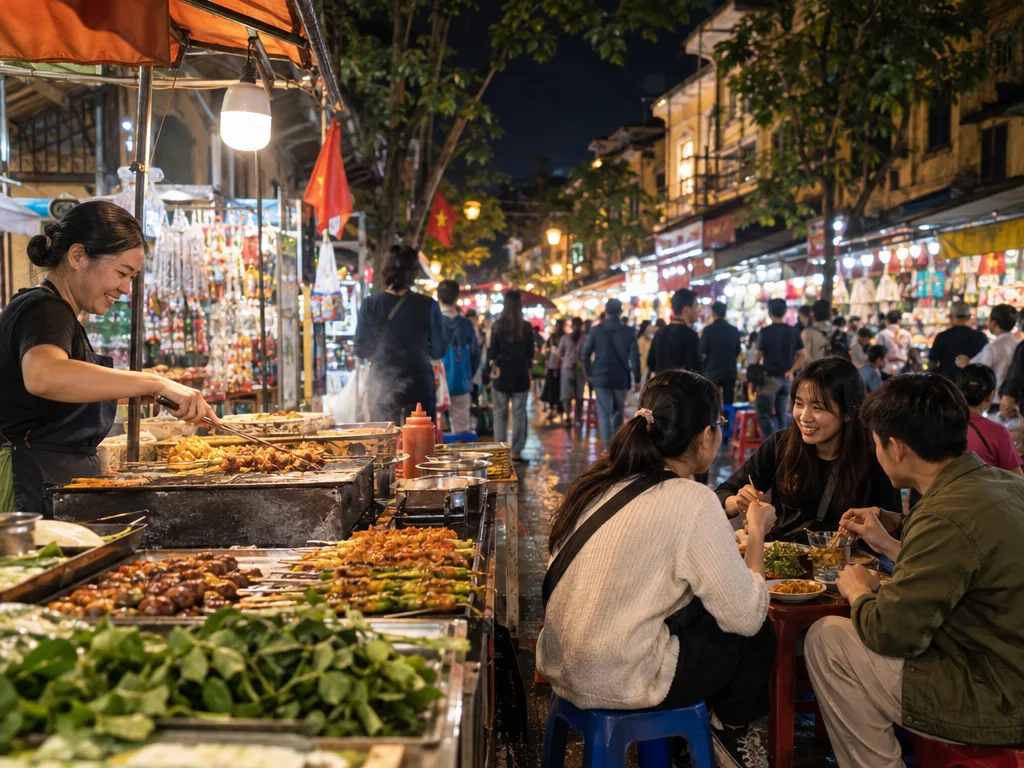
Hanoi’s night markets are easy to approach as a simple food stop, but the best experience comes from understanding the rhythm around the food. A little patience helps you choose a busy stall, order clearly, share narrow tables, and keep browsing without turning the market into a rushed checklist. This practical guide explains how to eat at a Hanoi night market respectfully, what to look for, how to manage portions, and how to build an evening that feels social rather than stressful.
What makes eating at a Hanoi night market different?
A night market is not the same as a restaurant with a fixed menu and a private table. Food may be prepared in small batches, displayed beside other goods, or served from a stall where the cooking, payment, and seating happen in a tight space. The market is also a moving public place: shoppers pause, vendors restock, families browse, and visitors make decisions while standing.
That setting changes the goal. You are not trying to find one perfect dish and settle in for a long meal. Instead, think in small rounds. Choose one or two items, taste them while they are fresh, then decide whether you want something else. This approach leaves room for surprises and makes it easier to share food with a companion.
How to choose a food stall with confidence
Start by walking a short circuit before buying. Look for stalls with a clear flow of customers and ingredients that are being handled actively. A queue is not an automatic guarantee of quality, but it often shows that the stall has a working rhythm and that food is not sitting untouched for long periods.
- Watch how the vendor manages cooked food, raw ingredients, utensils, and money.
- Choose a stall where the portion, price method, or ordering process is understandable before you commit.
- Notice whether locals are eating there, especially when you are comparing several similar stalls.
- Prefer food cooked to order when you want a hot snack rather than a display item.
- Keep your first purchase modest so you can compare flavours across the market.
Do not mistake a quiet stall for a bad one, particularly early in the evening or away from the busiest lane. The useful test is clarity: can you see what is available, understand what you are receiving, and communicate the order without pressure? If not, move on politely.
Ordering food without confusion
Many market transactions are quick and practical. Pointing, showing a number with your fingers, or using a translation app can help, but a calm attitude matters more than perfect language. Before ordering, establish the basic details: what the item is, whether it is one portion or several pieces, and how the price is calculated.
If a menu is visible, take a moment to read it rather than assuming that every item costs the same. When no price is displayed, ask before the food is prepared. You can use a short phrase such as “bao nhiêu?” or show the amount you want to confirm on a calculator. This is not confrontational; it is a normal way to make a small purchase clear for both sides.
Be specific about preferences that genuinely matter. If you cannot eat an ingredient, say so before the order is made, and understand that a market stall may not be able to guarantee separation. For ordinary preferences, such as less chilli or no extra herbs, point to the ingredient and ask simply. Avoid creating a complicated custom order during the busiest moment.
What to eat first: a flexible tasting strategy
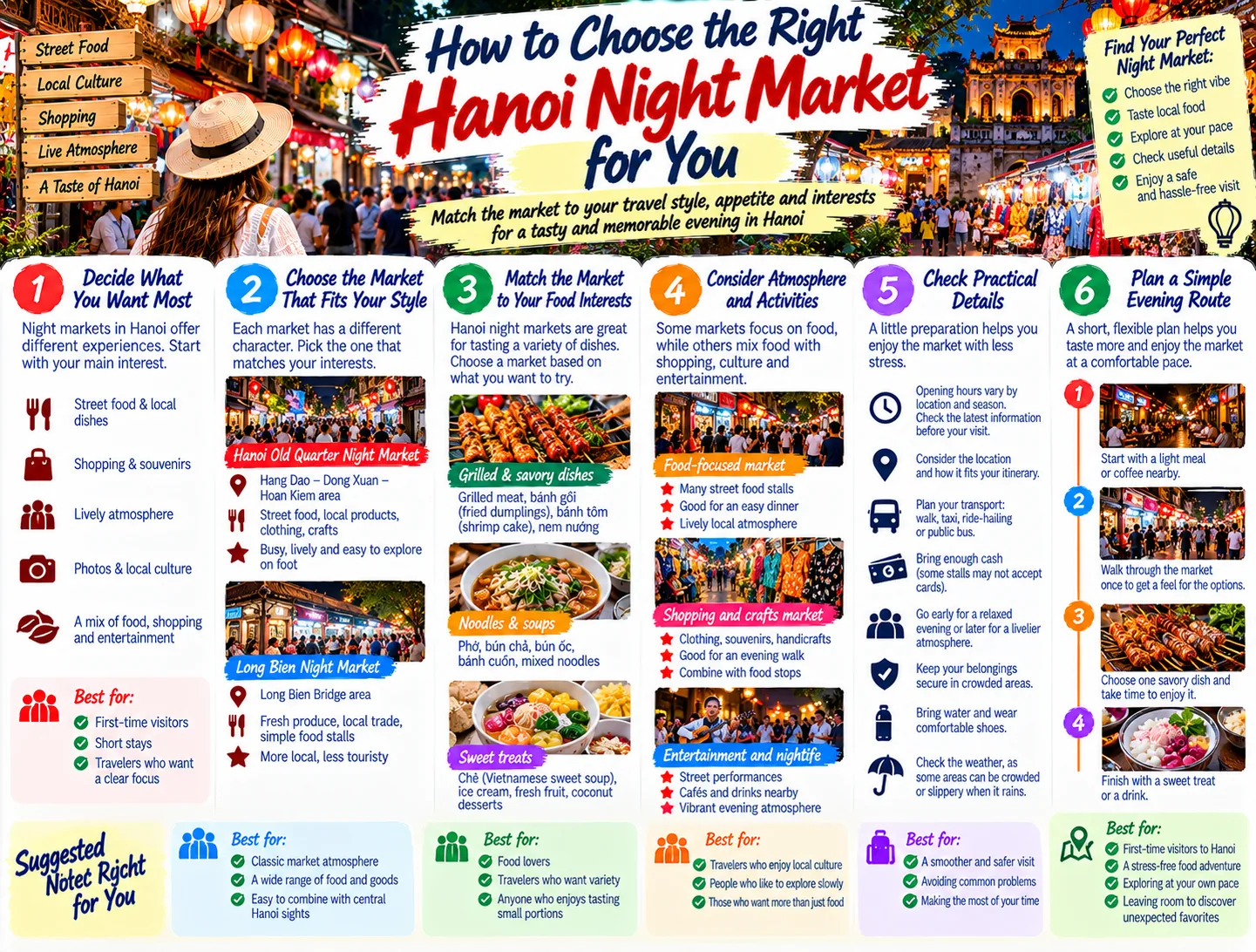
A good night-market route balances texture, temperature, and richness. Begin with a small savoury snack or grilled item, then add something fresh, brothy, or light if it is available. Finish with fruit, a sweet bite, or a drink only if you still have room. This is more comfortable than buying several heavy foods at once.
Build your evening in small portions
- First round: choose a signature-looking snack that can be eaten while standing or at a shared seat.
- Second round: try a different texture, such as something crisp, chewy, soft, or herb-filled.
- Third round: pause before ordering again; markets are more enjoyable when you keep browsing.
- Final round: choose a cooling drink or sweet item if it suits the weather and your appetite.
Dish names and availability vary by stall and season, so treat the list as a method rather than a fixed menu. You may see familiar Vietnamese street-food favourites, regional snacks, grilled foods, fruit, and drinks, but the most useful question is often “What is good now?” A vendor may be preparing a fresh batch that is not obvious from a sign.
Shared seating, walking, and market manners
Seating can be limited, especially around popular food areas. If a stall provides small stools or a narrow table, take the space you need and leave room for the next customer. Keep bags close to your feet or in front of you rather than spreading them across a seat. When you finish, return the stool if that is the local arrangement and clear wrappers or tissues into the bin provided.
Some foods are designed to be carried while walking; others are much easier to eat while seated. Follow the practical cues around you. Avoid stopping in the centre of a narrow lane to photograph a bowl or discuss your next order. Step to the side, let people pass, and ask before photographing a vendor, worker, or customer. A market is a workplace as well as a visitor experience.
Keep your voice and gestures measured. Haggling is not automatically appropriate for prepared food, where the price may already be set and the vendor is serving many people. If you are buying packaged goods or several items, a friendly question about the total is reasonable; pressuring a vendor over a small difference is not part of eating well.
Paying, carrying cash, and keeping track of your order
Have small notes ready when possible, but do not wave money around or leave a wallet open in a crowded lane. Confirm whether payment is made before eating, after eating, or at a separate counter. If a companion is ordering several items, keep a simple mental or written list so that the final total is easy to check.
When a vendor hands you food, check that it matches the order before stepping away. This is especially helpful when several customers are receiving similar cups, skewers, or bowls. If something is missing, point it out immediately and politely. Do not accuse the vendor when a busy handoff has simply become mixed up.
For takeaway food, ask whether the container is secure and keep hot items upright. Bring your own reusable bag if you have one, but do not expect every stall to provide the same packaging. If you are staying in a hotel, carry sauces and broth carefully and eat promptly rather than letting delicate food sit for a long time.
Dietary needs and food safety decisions
Visitors with allergies or strict dietary requirements should plan conservatively. A translated sentence can help explain a need, but it does not remove the risk of shared grills, broths, sauces, knives, or frying oil. If a reaction would be serious, choose a venue that can communicate clearly and handle the requirement reliably instead of relying on a fast market transaction.
For general comfort, choose food that is hot, freshly prepared, or served from a stall with a steady turnover. Notice whether serving utensils look clean and whether cooked food is protected from unnecessary handling. These observations are not a guarantee, but they are sensible ways to make a decision when you have many choices.
Carry water, pace yourself, and avoid treating every stall as a challenge to complete. If you feel unwell, stop eating, rest, and seek appropriate local medical advice. The point of a market visit is discovery, not endurance.
How to plan a relaxed Hanoi night-market route
Choose a starting point, but leave the middle of the evening open. Begin with a walk through the market, return to the stalls that genuinely interest you, and add food gradually. A route of a few focused stops is usually more satisfying than trying to cover every lane. Build in a pause away from the busiest flow so you can drink water, check your belongings, and decide what you want next.
Timing should remain flexible. Markets can feel different at the beginning of an evening, during the busiest period, and near closing. Stalls may sell out, restock, or change pace. Check the current market schedule through a reliable local or official source before you go, particularly if your visit depends on a particular night. Vietnam’s national tourism website also treats food and culinary experiences as a major way to explore the country, while its current Hanoi event listings show how gastronomy and local culture can overlap during city celebrations.
For a fuller plan, combine the market with one nearby café, a quiet walk, or a restaurant meal rather than stacking several large meals together. This keeps the evening comfortable and gives you time to notice the neighbourhood beyond the food stalls.
Common mistakes to avoid
- Buying a large portion before seeing what else is available.
- Assuming a busy stall can explain every ingredient in detail during a rush.
- Ignoring the price or portion size until after the food is prepared.
- Blocking a narrow lane while taking photos or deciding what to order.
- Taking a seat for a long time after finishing when other customers are waiting.
- Expecting every stall to accept cards, speak English, or adapt a dish to strict dietary rules.
- Turning a small price difference into an uncomfortable argument.
A simple checklist for a better market evening
Before you leave, carry modest cash, a phone with translation access, and a small bag for anything you buy. Once you arrive, walk first, choose a stall with a clear rhythm, confirm the order and price, and start with one portion. Eat attentively, share space, and pause before adding more. If a transaction feels unclear or rushed, you can thank the vendor and continue looking.
The most memorable Hanoi night-market meals are rarely about collecting the largest number of dishes. They come from noticing how food moves through the market: a vendor preparing a fresh batch, a family sharing a small table, or a familiar snack becoming more interesting because you took time to understand it. Approach the market with curiosity, restraint, and respect, and the evening will usually take care of itself.
JOIN THE CONVERSATION
Comments (0)
No comments yet. Be the first to share a thought.