Hanoi food markets are more than places to buy a quick snack. They are working spaces where fresh herbs, noodles, seafood, fruit, spices, cooked dishes, and everyday conversation meet. For a visitor, the best approach is not to rush through every aisle or treat the market like a checklist. Instead, arrive with a simple plan: understand what kind of market you are entering, notice how ingredients are arranged, choose a few foods that are easy to share, and leave room for the unexpected.
This guide focuses on how to shop and taste at Hanoi food markets with confidence. It is designed for travellers who want a practical market experience rather than a list of supposedly “best” stalls. You will learn how to choose a time, read the scene, order small portions, ask useful questions, manage money and belongings, and build a respectful route through a busy market.
Choose the right kind of Hanoi food market
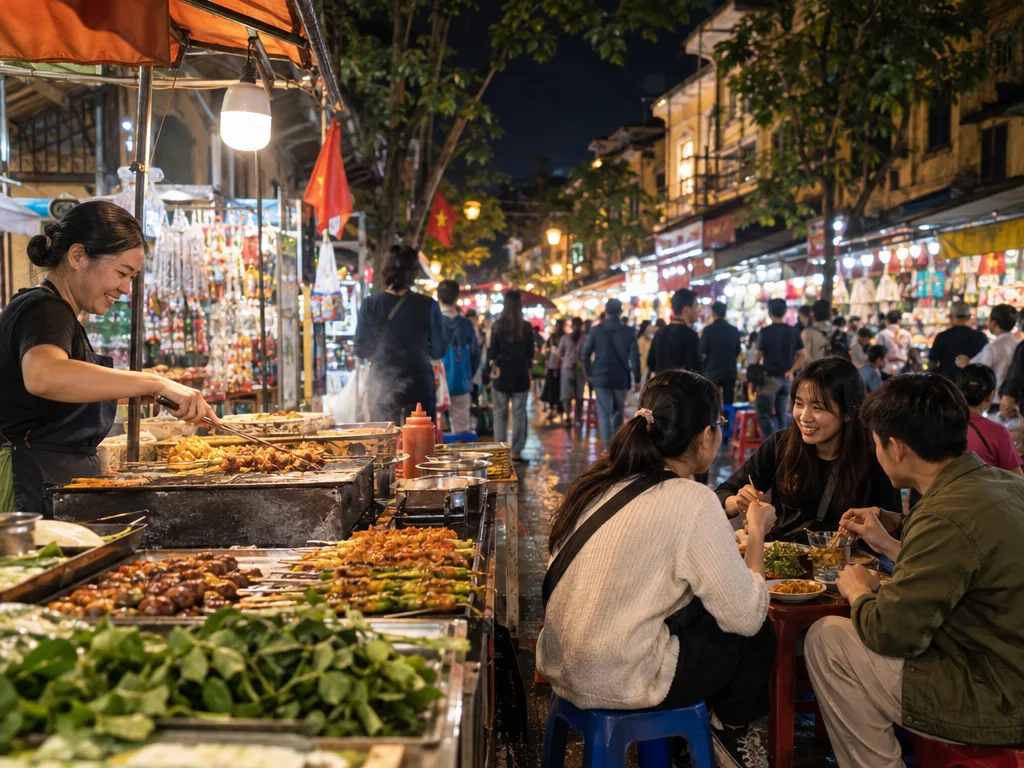
“Hanoi food market” can describe several different experiences. A covered wholesale or produce market is primarily a working environment: people are buying ingredients, deliveries are moving, and the pace may be brisk. A neighbourhood market is often more useful for seeing everyday shopping, with vegetables, herbs, tofu, meat, fish, fruit, and prepared foods arranged for local households. A night market is more focused on strolling, snacks, small goods, and social atmosphere.
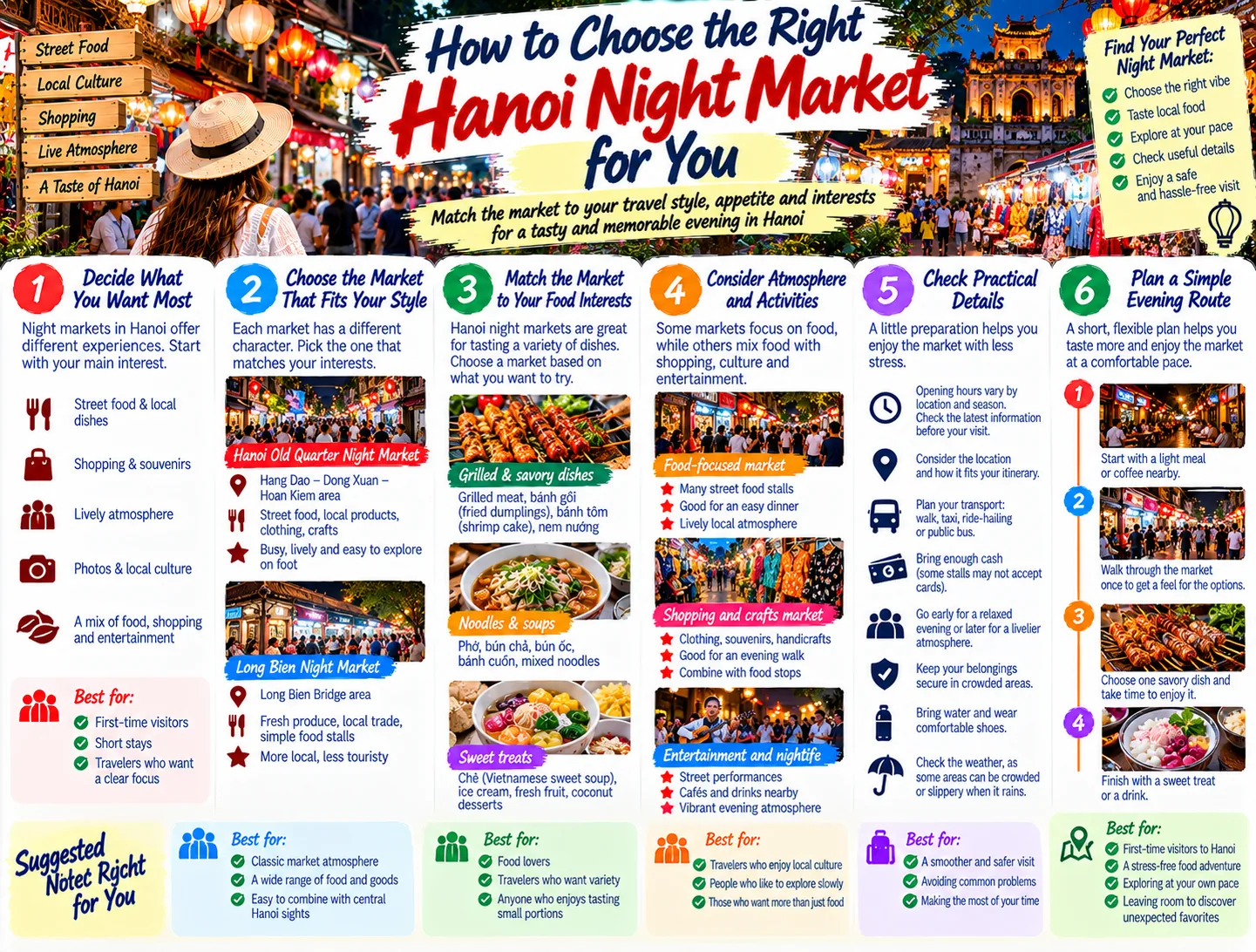
Decide what you want before you go. If your priority is ingredients and local shopping habits, choose a daytime market and keep your visit observational. If you want a relaxed evening of tasting, choose a pedestrianised night-market setting and plan several small stops instead of one large meal. If you are interested in photography, a quieter edge of the market may be more considerate than the centre of a busy transaction.
- For everyday food culture: look for a neighbourhood produce market.
- For a broad market landmark: allow time to explore without blocking working aisles.
- For snacks and atmosphere: choose a night market and share several portions.
- For ingredients to take home: confirm what can legally travel before buying anything perishable.
Plan your visit around the market’s rhythm
Markets change character during the day. Early hours can feel focused and practical, while later visits may be better for cooked snacks and a slower wander. There is no universal “best time” for every traveller. The right choice depends on whether you want to watch shopping, eat prepared food, or combine both.
A useful first visit lasts about 60 to 90 minutes. Start with a complete walk-through before buying anything. This lets you see which areas sell raw ingredients, which stalls serve ready-to-eat food, and where customers are already stopping. Then return to one or two places that look suitable. For a night-market visit, two hours is enough for a compact route with pauses, though you should treat this as a planning estimate rather than a fixed schedule.
Wear shoes that are comfortable on uneven or crowded surfaces. Keep your bag close, avoid spreading belongings across a small table, and carry only what you need. A market visit works better when you can move easily and pay without a long search through your wallet.
Read a stall before you order
Busy does not automatically mean better, but a steady flow of local customers can show that a stall is part of the area’s normal food routine. Look for clear signs of what is being served, ingredients that are being replenished, and a preparation space that appears organised. Watch how customers order and where they sit. This will often answer practical questions before you need to ask them.
At a cooked-food stall, identify the base of the dish first: rice noodles, flat rice noodles, sticky rice, bread, rice, or a broth. Then notice the main topping and the herbs or sauce served alongside it. Vietnam Tourism’s official food guide describes Hanoi specialities including bánh cuốn, bún ốc, bún cá, bánh tôm, bánh gối, bánh đúc nóng, and chè, alongside the better-known phở, bún chả, and bánh mì. You do not need to try everything. Choose one familiar dish and one item that is new to you.
At an ingredient stall, observe how herbs, greens, noodles, tofu, fruit, and seasonings are grouped. Hanoi’s culinary identity depends heavily on fresh ingredients, and the national tourism authority notes that wholesale and local produce markets supply herbs, spring onions, lemongrass, lime leaves, meats, fish, and distinctive seasonings for the city’s kitchens. That is why a market walk can teach you as much about preparation as a restaurant meal.
Order small, shareable portions first
The most common mistake on a first market visit is ordering a full meal before understanding the portion size or flavour profile. Start with one item, watch how it is served, and decide whether you want another stop. If you are travelling with others, sharing makes it easier to compare dishes and reduces waste.
Good first choices
- A noodle dish with herbs and a separate sauce, so you can adjust the balance.
- A small fried snack such as bánh gối or bánh tôm when it is being served hot.
- A sweet finish such as chè after savoury dishes.
- A drink or coffee pause between market sections rather than adding another heavy dish.
Ask whether an item is spicy, sweet, sour, fried, or served cold if you are unsure. Pointing to a visible portion can help when a menu is limited. If you have allergies or follow a strict diet, be direct and understand that a market stall may not be able to guarantee separation of ingredients. “Vegetarian” and “vegan” are not interchangeable requests, so explain your needs clearly and choose a setting where the staff can answer confidently.
Use simple Vietnamese market phrases
You do not need fluent Vietnamese to order politely, but a few words make the interaction smoother. “Bao nhiêu?” means “How much?” “Không cay” means “not spicy.” “Ít cay” means “a little spicy.” “Không thịt” means “no meat,” though people with strict dietary requirements should ask follow-up questions about broth, fish sauce, shrimp paste, and cooking surfaces. “Cho tôi một phần” means “one portion, please.” A smile, a clear point, and patience are just as helpful as pronunciation.
- Xin chào — hello.
- Cảm ơn — thank you.
- Bao nhiêu tiền? — how much does it cost?
- Ít thôi — just a little.
- Không hành — no spring onion, if that is important to you.
- Mang đi — takeaway.
Repeat the price before handing over money if you are uncertain, especially when several dishes are being ordered at once. Keep the exchange calm. A market is a shared working environment, not a stage for testing language skills.
Handle prices, cash, and bargaining thoughtfully
For prepared food, ask the price before ordering when it is not displayed. For produce or packaged ingredients, check how the item is weighed and whether the price is per portion, bundle, or kilogram. If you are buying something small, it is usually more useful to clarify the total than to negotiate over a minor difference.
Bargaining may be part of some shopping interactions, but it is not appropriate to treat every purchase as a contest. Look at how local customers behave, keep your tone friendly, and walk away politely if the price does not suit you. Do not handle fragile produce unnecessarily, and do not photograph a person’s stall or goods at close range without permission.
Carry smaller notes when possible and count your change discreetly. Separate the money you plan to spend from the rest of your belongings. These small habits reduce stress in crowded spaces and help you stay focused on the food rather than on managing your bag.
Eat comfortably and observe market etiquette
Market seating may be limited, shared, or arranged close to other customers. Take the space you need, leave room for people to pass, and return bowls or cups where staff indicate. If a stall is full, move on and come back later rather than waiting in the middle of an aisle.
Be especially careful with photography. A wide scene taken from a respectful distance is different from photographing someone’s face, hands, money, or family without asking. If a vendor is serving a customer, wait until the transaction is complete. This is both considerate and practical: the best market images usually come from watching patiently rather than interrupting work.
Food safety is also a matter of choosing what suits your comfort level. Favour dishes cooked to order or served hot when that is your preference, and avoid buying more than you can eat soon. Keep raw and cooked foods conceptually separate when shopping, and use your own judgement about foods that have been sitting out. These are general travel precautions, not a guarantee about any individual stall.
Build a simple Hanoi market tasting route
A flexible route is better than trying to cover an entire district. Begin with a slow orientation walk. Next, choose one savoury dish, then move to a second section for a snack or ingredient-focused stop. Finish with fruit, chè, or coffee if you still have room. This sequence gives your palate variety and keeps the experience from becoming a hurried succession of heavy dishes.
- Spend 15 minutes walking without ordering.
- Choose one main dish that shows a local noodle, rice, or bread tradition.
- Share one snack, such as a fried item, rather than ordering several individual portions.
- Pause somewhere that does not obstruct shoppers or stall workers.
- End with a light sweet, fruit, or coffee and note what you would try next time.
For a night-market route, favour foods that are easy to carry and eat in small bites. For a daytime produce market, make the market itself the main attraction and treat prepared food as a supporting stop. The official Vietnam Tourism guide’s descriptions of Hanoi dishes are useful inspiration, but the best choice on the day will depend on what is actually being prepared and served when you arrive.
Know what to skip and how to leave well
You can politely decline a purchase by smiling, shaking your head, and continuing. You do not have to try a dish that makes you uncomfortable, and you should not buy food simply because you feel pressured. If a stall cannot answer a key dietary question, choose another one.
Before leaving, check that you have your phone, wallet, and any small purchases. Dispose of waste in the appropriate place and avoid leaving packaging on a table or pavement. If you enjoyed a stall, a brief thank-you and a return visit are more meaningful than exaggerated praise or intrusive filming.
Make your next market visit more rewarding
After your first visit, write down three things: a dish you would order again, an ingredient you did not recognise, and one question you would ask next time. This turns a quick food stop into a learning habit. You may discover that you prefer the calm observation of a morning produce market, the focused energy of a working market, or the social atmosphere of an evening food route.
Hanoi’s markets are valuable because they connect food with movement, seasonality, work, and ordinary routines. Approach them with curiosity rather than a demand for a perfect “local” performance. Walk slowly, order modestly, ask before photographing, and let the market decide the details of your meal.
JOIN THE CONVERSATION
Comments (0)
No comments yet. Be the first to share a thought.