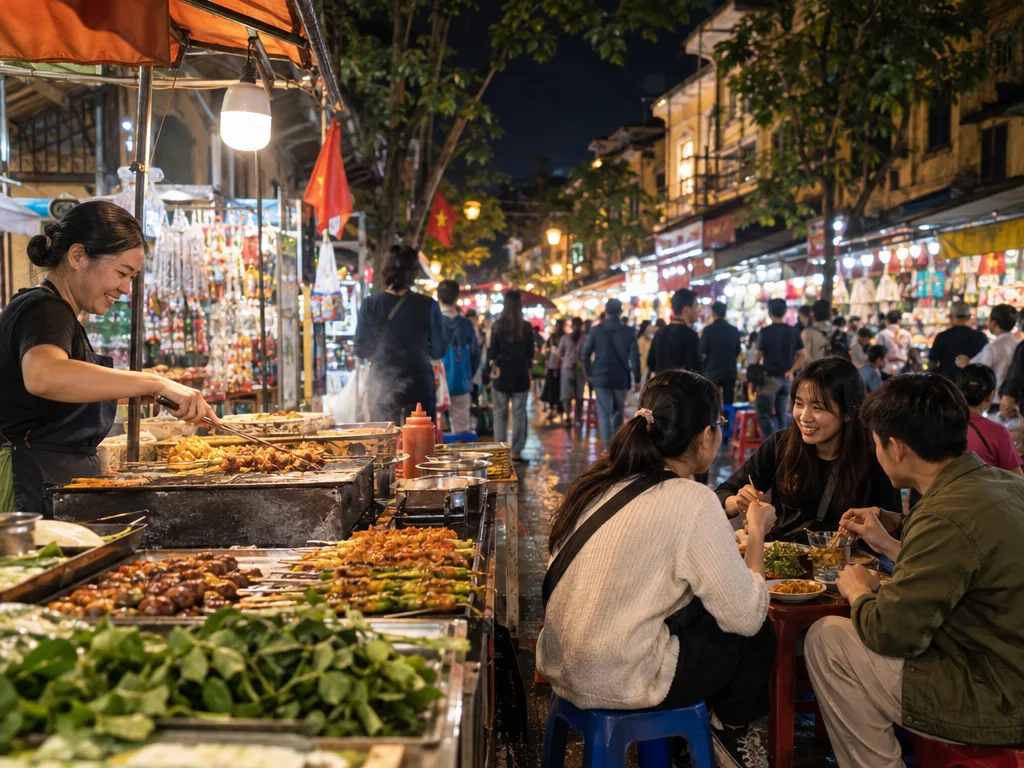
Hanoi night markets are easiest to enjoy when you treat them as a moving meal rather than a shopping stop with a few snacks. You browse, notice what is being cooked, order one small portion, share it, and keep walking. That approach leaves room for the city’s most rewarding market foods: grilled bites, crisp pastries, noodles, sweet soups, fresh herbs, and drinks that appear at low tables along the pedestrian streets.
This Hanoi night market food guide focuses on the decisions that make an evening work: what to look for, how to build a balanced tasting route, which local dishes are worth recognising, and how to handle crowds, heat, spice, and unfamiliar ingredients. It is designed for first-time visitors who want a practical plan without turning the market into a checklist.
What makes Hanoi night-market eating different?
Hanoi’s food culture is strongly connected to street life. The official Vietnam Tourism guide describes the Old Quarter as a lively historic area and highlights weekend night markets as places to browse crafts, souvenirs, and street displays. Food is part of that atmosphere, but the best experience is not necessarily one famous stall. It is the rhythm of moving through a dense neighbourhood, comparing aromas, and seeing how a snack is assembled in front of you.
Markets also reward curiosity because Hanoi food is more varied than the familiar trio of phở, bún chả, and bánh mì. Vietnam Tourism’s dedicated Hanoi food guide lists dishes such as bánh cuốn, bún ốc, bánh tôm, bánh gối, bánh đúc nóng, and chè alongside the better-known staples. That variety creates a useful strategy: start with a recognisable dish, add one local speciality, then finish with something sweet.
For background before you go, the site’s curious walk through a Hanoi market offers a complementary way to think about market atmosphere, while the Food Markets & Night Markets category collects more ideas for exploring the city after dark.
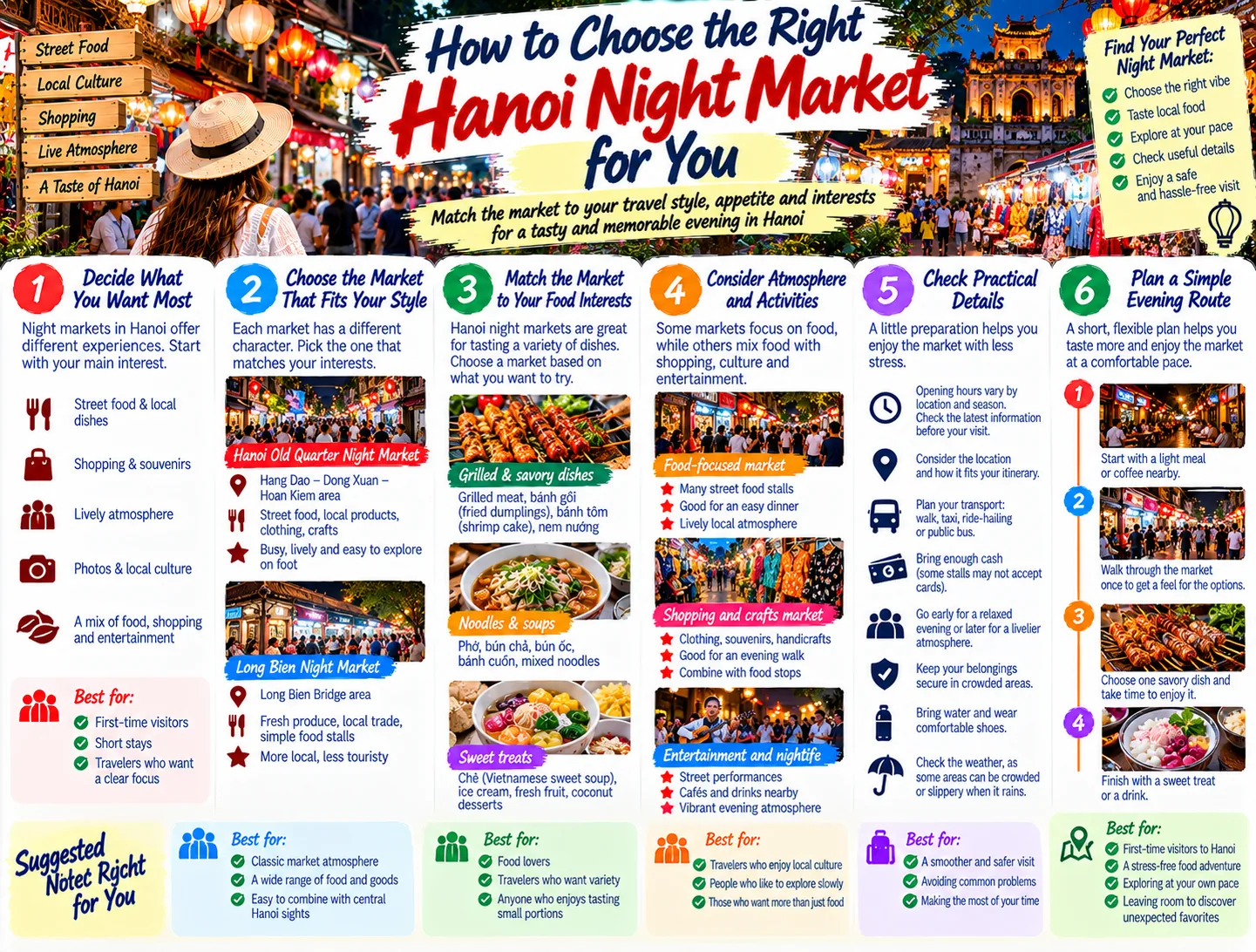
How to plan a Hanoi night market food route
Arrive with a tasting plan, not a full stomach
Eat lightly earlier in the day so you can sample several small portions. A market meal works better as four or five modest stops than as one large plate followed by an early exit. If you are travelling with someone, agree to share whenever possible. Two people can try twice as many textures without wasting food, and sharing also makes unfamiliar dishes less intimidating.
Use a simple three-part sequence
- Warm or savoury opening: choose noodles, a grilled item, or a filled pastry.
- Crisp or fresh middle: look for fried snacks, herbs, pickles, or a dish with a bright dipping sauce.
- Sweet finish: try chè, fruit, or a cool drink rather than adding another heavy savoury plate.
Keep the route flexible. A stall with a steady line and food being cooked continuously may be a better choice than the stand you saved on a map. Conversely, a quiet stall is not automatically poor; it may simply be between rushes. Watch the cooking, check that ingredients are being handled cleanly, and choose portions that are served hot when that is part of the dish.
Choose a meeting point
Night markets can feel visually similar after several turns. Pick a landmark or a broad pedestrian stretch as your regrouping point, especially if your party includes children or anyone who dislikes crowds. Keep phones and wallets secure in busy areas, and avoid stopping in the centre of a narrow flow of pedestrians. A short pause at the edge is more comfortable for everyone.
What to eat first: familiar Hanoi favourites
Phở and bún chả when you want a proper anchor
Not every night market is the ideal place for a full bowl of phở or a complete serving of bún chả, but these dishes are useful reference points. Phở brings a hot, aromatic broth with rice noodles and meat; bún chả combines grilled pork, rice vermicelli, herbs, and dipping sauce. If you see them served in small portions, they can anchor the evening. If not, save them for a dedicated meal and use the market for snacks.
The site’s practical Hanoi street-food guide explains how to think about ordering and neighbourhood eating more broadly. Pair it with the Hanoi Street Food category if you want to compare a market snack route with a full street-food crawl.
Bánh mì for an easy handheld option
Bánh mì is convenient when you want to keep walking. Look for a crisp baguette filled with savoury ingredients, pickles, herbs, and sauce. Because fillings vary, watch how the vendor assembles it and point to ingredients if you want a simpler version. Ask for less chilli if you are sensitive to heat; do not assume every red sauce is merely decorative.
Egg coffee and bia hơi as a pause
Hanoi’s official tourism page identifies egg coffee and bia hơi among the city’s signature flavours. At a market-area café or street corner, either can become a useful pause between food stops. Egg coffee is rich and dessert-like, so it may work better near the end. Bia hơi is a social drink traditionally associated with low stools and lively streets; if you choose it, sit down rather than trying to carry it through the busiest pedestrian flow.
Local snacks worth recognising at the market
Bánh gối and other fried pastries
Bánh gối is a crisp, pillow-shaped pastry with a savoury filling. It is a good first-timer snack because it is familiar in format but distinctly local in flavour. Break it open carefully, add dipping sauce gradually, and share one before ordering more. Nearby stalls may offer other fried bites such as dumplings or cheese sticks. Treat these as a tasting flight rather than a large basket: fried foods become filling quickly.
Bánh tôm from the West Lake tradition
Vietnam Tourism describes bánh tôm as a Hanoi speciality associated with West Lake, made with prawns and sweet potato in batter and served with a sweet-and-sour sauce. It brings a useful contrast to noodles: crisp outside, soft and savoury inside, with sauce and vegetables adding freshness. Ask whether the portion is made to order, and eat it soon after serving so the texture stays at its best.
Bánh cuốn and flat-noodle dishes
Bánh cuốn consists of delicate steamed rice rolls, often accompanied by fried shallots, herbs, and a sweet-sour fish sauce. It is softer and lighter than a fried snack, making it a sensible middle course. You may also encounter mixed flat rice noodles or glass-noodle dishes with fish cake, sausage, tofu, peanuts, and greens. These are useful choices when you want something substantial without ordering a large soup.
Bún ốc, eel noodles, and adventurous bowls
Bún ốc is a classic snail-and-vermicelli soup with a bright, tangy broth. Eel dishes may appear as stir-fried glass noodles, tossed noodles, or porridge. They are not obligatory, but a market is a good place to try one unfamiliar dish in a small portion. If you have allergies, ask what is in the bowl before ordering, especially when seafood, peanuts, or shared sauces are involved.
How to order when you do not speak Vietnamese
Pointing works surprisingly well when the food is visible. First watch a nearby order, then indicate the portion you want. Use a translation app for ingredients or dietary restrictions, but keep the request short and concrete. “No peanuts,” “no fish sauce,” or “less chilli” is easier to communicate than a long explanation.
Learn a few useful words: không cay means not spicy, ít cay means less spicy, and cảm ơn means thank you. Pronunciation does not need to be perfect; a friendly attempt plus a clear gesture is usually enough. Before sitting, check whether the price is shown, whether the dish is sold by portion or by weight, and whether drinks are separate. If anything is unclear, ask before the food is prepared.
For a wider planning framework, the Hanoi Food Guides category is useful alongside the site’s guide to choosing restaurants in Hanoi. Those resources help you decide when a market snack is enough and when you should move to a seated local eatery.
Dietary, hygiene, and comfort decisions
Vegetarian and allergy questions
Do not rely on a dish name alone to identify vegetarian food. Broths, dipping sauces, fillings, and toppings may contain fish sauce, shrimp, meat stock, or dried seafood. If you eat vegetarian, explain the restriction before ordering and choose visibly vegetable-forward items only when the preparation is clear. The site’s Vegetarian & Special Diets category can help you plan beyond the market.
Choose the stall you can observe
Look for ingredients that are protected from dust and unnecessary handling, utensils that are used consistently, and food that is cooked or reheated as part of the order. These observations are not a guarantee, but they help you make a sensible choice in a busy environment. Carry hand sanitiser, drink water, and take a break if the heat, smoke, or crowd becomes tiring.
Dress and move for the evening
Wear comfortable shoes and clothing that can handle a little smoke or sauce. Keep bags close to your body and leave space for scooters, vendors, and other walkers. A market evening is more enjoyable when you do not rush every bite or block the stall while deciding.
A practical two-hour sample itinerary
- First 20 minutes: walk once without ordering. Note the busiest food stalls, seating options, and any dish you cannot identify.
- Next 30 minutes: share one familiar savoury item such as bánh mì, a small noodle dish, or grilled food.
- Next 30 minutes: try one Hanoi snack, such as bánh gối, bánh tôm, bánh cuốn, or a mixed noodle dish.
- Next 20 minutes: sit down for a drink, check how everyone feels, and decide whether to continue.
- Final 20 minutes: finish with chè, egg coffee, fruit, or a small sweet, then walk away from the densest crowds before calling a ride.
This sequence keeps the evening varied without making it a competition. You can replace any dish with a safer familiar choice, and you can stop early. The goal is to leave with a clear memory of Hanoi’s food culture, not a record of how much you managed to consume.
Common mistakes to avoid
- Ordering too much at the first stall: start with one portion and build gradually.
- Choosing only famous dishes: leave room for a local snack or dessert that you may not find in a standard restaurant.
- Ignoring texture: eat fried foods promptly and keep sauces separate when possible.
- Assuming every market has the same food: treat each area as a changing mix of stalls rather than a fixed menu.
- Forgetting to rest: a drink and a seat can improve the second half of the evening.
Final thoughts
The best Hanoi night market food experience is paced, shared, and observant. Begin with a manageable dish, use the official food vocabulary as a map rather than a rulebook, and let the market show you what is fresh and popular that evening. With a little planning, you can move from familiar noodles to crisp pastries, regional snacks, and a sweet Hanoi-style finish without feeling overwhelmed.
JOIN THE CONVERSATION
Comments (0)
No comments yet. Be the first to share a thought.