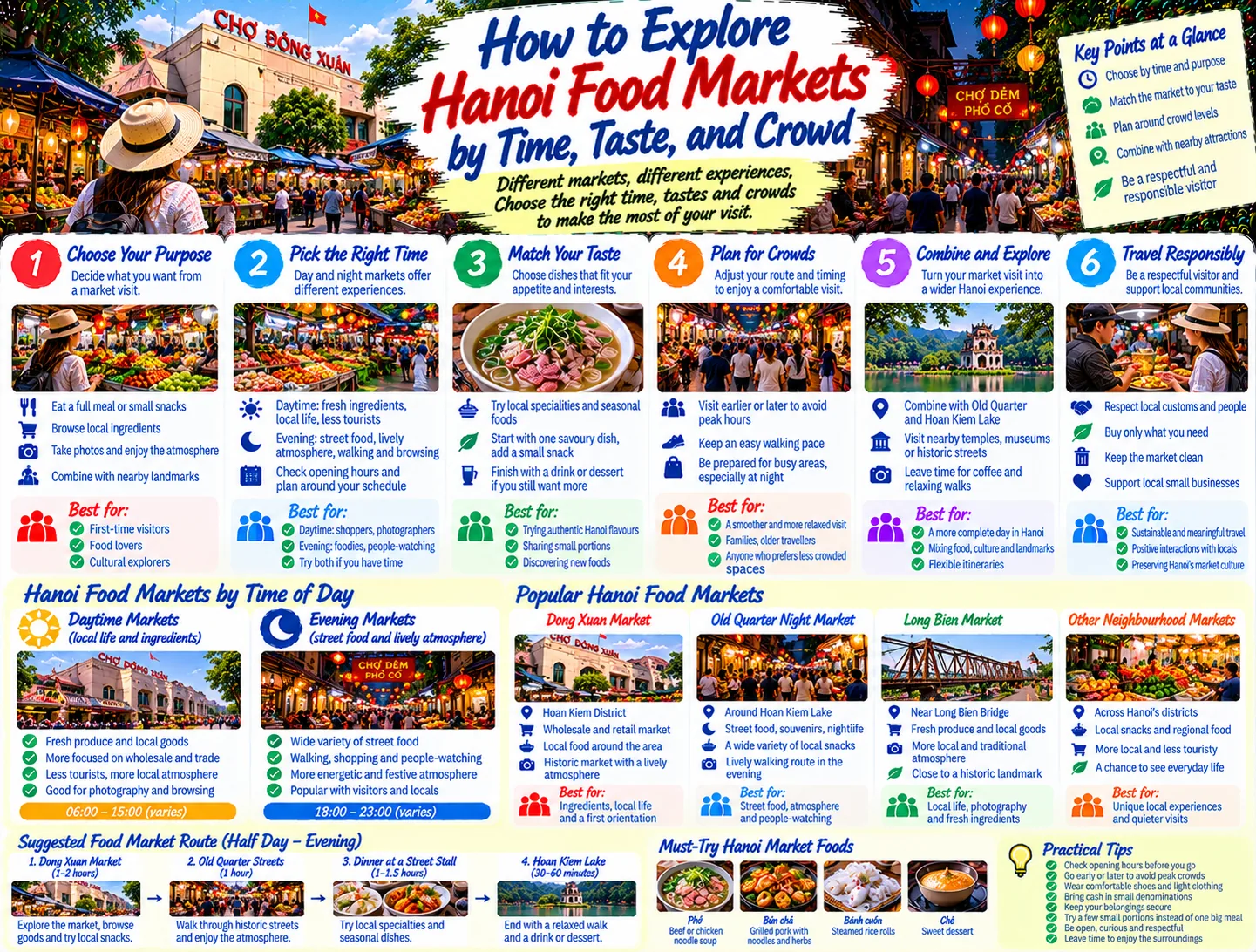
Hanoi’s food markets are not one single attraction. They are a set of different experiences: a covered wholesale market, a lively evening walk, a neighbourhood trading street, and a place to taste small portions while the city changes around you. The best way to explore them is to match the market to your time, appetite, and tolerance for crowds rather than trying to “do” every market in one rushed evening.
This guide focuses on how to plan a Hanoi food market visit, what to eat first, how to move through a busy market respectfully, and how to decide between a daytime market and a night market. For a broader overview, compare it with the practical guide to Hanoi’s best food markets, then use the narrower framework below to shape your own route.
Start with the market experience you actually want
Before choosing a destination, decide what “market” means for this outing. A visitor looking for a proper meal needs a different plan from someone who wants to browse ingredients, photograph old streets, or sample several snacks. This simple choice prevents the common mistake of arriving hungry at a market that is better for shopping than sitting down.
Choose by purpose
For a first orientation: choose a central market area where you can combine food, streets, and landmarks in one walk.
For serious browsing: a covered market is useful because stalls are concentrated and the atmosphere feels more local and commercial.
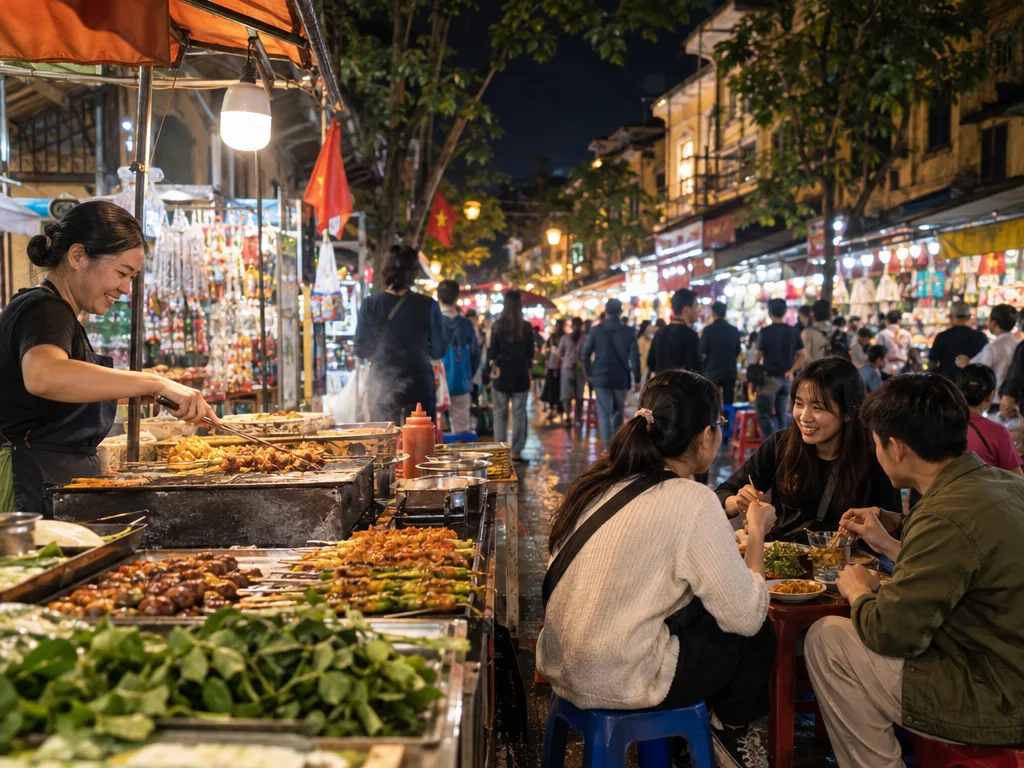
For snacks and people-watching: an evening market suits a slow, flexible route with small purchases rather than one large meal.
For ingredients: visit earlier, when produce and everyday goods are more central to the experience.
Hanoi’s market culture rewards curiosity, but it also rewards restraint. You do not need to buy something from every stall. A market visit is often more enjoyable when you pause, watch how locals choose food, and make two or three thoughtful stops.
Understand the role of Dong Xuan Market
Dong Xuan Market is a useful anchor for understanding Hanoi’s market geography. The covered market sits in the Hoan Kiem district and has roots reaching back to the late nineteenth century. It is associated with wholesale and retail trading, with clothing, household goods, foodstuffs, and prepared dishes appearing in different parts of the market. That mix makes it different from a night market designed mainly as an evening visitor experience.
Plan to explore Dong Xuan as a trading environment first and a food stop second. Look for the rhythm of deliveries, bargaining, storage, and movement between stalls. Food may be found around the market, but the strongest experience comes from seeing how commerce works rather than expecting a curated food hall.
The market’s history also explains why it works well as a starting point for a wider Old Quarter walk. Its present form follows rebuilding after a major fire in 1994, while the surrounding district retains a dense commercial character. If you want a slower introduction before tackling a busier evening route, read this curious walk through a Hanoi market for a complementary way to observe the setting.
Day markets and night markets answer different questions
A daytime market helps you understand what Hanoi buys, stores, and cooks. You are more likely to notice fresh ingredients, household supplies, wholesalers, and the practical side of trade. A night market asks a different question: how does the same urban area become social, theatrical, and easy to explore on foot after dark?
Neither is automatically better. Choose daytime if you care about ingredients, working routines, and a less festive atmosphere. Choose evening if you want snack-sized tasting, browsing, street energy, and a route that can expand or end whenever you like. If your schedule allows, visit once in each mode rather than trying to force both experiences into one short stop.
Hanoi’s city government is currently framing tourism around culture, heritage, creative experiences, and smarter, more sustainable visitor services. That direction is useful context: markets are not merely places to consume food. They are living urban spaces, and the most responsible visitor behaves like a guest in a working neighbourhood.
Build a food market route that does not overfill your stomach
The best market route has a beginning, a middle, and a deliberate stopping point. Start with observation, continue with one savoury dish, add a small snack, and finish with a drink or dessert only if you still want one. This sequence keeps you flexible when a stall looks appealing and helps you avoid buying a full meal before discovering something more interesting nearby.
A practical tasting sequence
Walk once before ordering. Notice which stalls are busy, what is being prepared fresh, and where people actually sit or stand to eat.
Choose one savoury anchor. A bowl, plate, or filled snack gives the visit structure without committing you to a long restaurant meal.
Add one portable bite. Pick something small enough to share or carry, especially if you plan to keep walking.
Pause before the next purchase. Markets are sensory environments; a short break helps you decide based on appetite rather than impulse.
Finish with a drink if useful. Coffee, tea, or a cold non-alcoholic drink can provide a calm ending and a chance to review your route.
For dish ideas beyond market stalls, use the site’s Hanoi street food category and Traditional Vietnamese Dishes category. They help you recognise familiar foods without turning the market into a checklist.
What to look for when choosing a stall
In a busy market, visual confidence can be misleading. Instead of searching for a perfect-looking stall, look for signs that the operation is active and understandable. A steady flow of customers usually tells you more than decorative presentation. Watch whether food is being prepared in front of you, whether ingredients are covered when appropriate, and whether the serving area is organised enough for the pace of trade.
Keep your order simple at first. Pointing, showing a small quantity, or asking for help from a companion can be easier than attempting a long explanation in a noisy aisle. If you have allergies, dietary restrictions, or a strong preference about ingredients, ask before ordering and be prepared to skip a dish when the answer is unclear. A market is not the right place to gamble with a serious allergy.
Carry small notes if you already have them, keep your phone and wallet secure in crowded areas, and avoid blocking a stall while deciding. These are not complicated rules, but they make the exchange more comfortable for both visitor and vendor.
Because market arrangements can change, treat any online description of a night market as a planning starting point rather than a guarantee. Before you leave, check the latest notice from your accommodation, a current local tourism channel, or the market’s own information if available. This matters especially around public holidays, heavy rain, neighbourhood events, and temporary street-management changes. If a stall, lane, or pedestrian area is quieter than expected, the outing has not failed: use the extra space to notice preparation methods, compare ingredients, or continue to a nearby local eatery. A good market route is adaptable by design.
How to handle crowds, heat, and sensory overload
Markets compress sound, movement, smells, and traffic into a small space. Give yourself permission to slow down. Stand to one side when taking a photograph, keep bags close to your body, and leave room for people carrying supplies. If the environment becomes tiring, step outside for ten minutes instead of treating discomfort as part of the challenge.
Weather also changes the experience. Warm, humid conditions can make a multi-stop tasting route feel heavier than expected, while rain may narrow walkways and change which stalls are practical. Build a backup plan around covered streets, a café break, or a nearby restaurant rather than promising yourself that every stop must happen outdoors.
Market etiquette is mostly observational: follow the flow, ask before photographing people closely, do not touch food or merchandise without permission, and accept that a vendor may be serving several customers at once. A patient visitor usually receives better guidance than a hurried one.
Match the market to your travel style
For first-time visitors
Keep the route short and central. One market, one savoury dish, one snack, and a nearby drink are enough for a first visit. The goal is to learn the pattern of Hanoi eating rather than collect proof that you visited every stall.
For curious repeat visitors
Return at a different time of day and focus on one theme: breakfast foods, ingredients, sweets, drinks, or the architecture of the trading streets. Repetition is valuable because markets reveal different details when you are not concentrating on basic navigation.
For families and mixed groups
Agree on a meeting point before entering, set a loose time limit, and let each person choose one item. Small portions reduce waste and make the outing easier for different appetites. A calm café or restaurant afterward can be useful if the market itself is too crowded for everyone.
For travellers who prefer a guided food walk
A guide can add context about ingredients, ordering, and neighbourhood history, especially if you want to sample several foods without making every decision alone. The site’s guide to Hanoi food tours for first-time visitors is a useful next step, while the Hanoi Food Tours category helps you compare the wider style of experience.
A simple plan for your next Hanoi market evening
Reserve enough time to walk rather than sprint, but do not create an itinerary so dense that every delay becomes a problem. Begin with a market loop, choose one dish after observing the stalls, and keep the second purchase optional. If a street is especially crowded, move with the flow and save detailed browsing for a quieter edge. If you are unsure about a food, ask what it contains and order a small portion rather than relying on a guess.
Most importantly, treat the market as a neighbourhood with its own purpose. Vendors are working, residents are shopping, and visitors are only one part of the scene. Your best memories may come from a bowl you had not planned to try, a short conversation, or the changing sound of the street—not from completing a predetermined list.
Conclusion: let the market set the pace
The best Hanoi food market experience is shaped by timing, appetite, and attention. Choose a daytime market when you want to understand everyday trade, an evening market when you want a social tasting walk, and Dong Xuan when you want a historic commercial anchor. Eat in small stages, ask questions before ordering, and leave space for the unexpected. With that approach, a market visit becomes more than a search for cheap bites: it becomes a practical way to read Hanoi through food, movement, and local life.
JOIN THE CONVERSATION
Comments (0)
No comments yet. Be the first to share a thought.