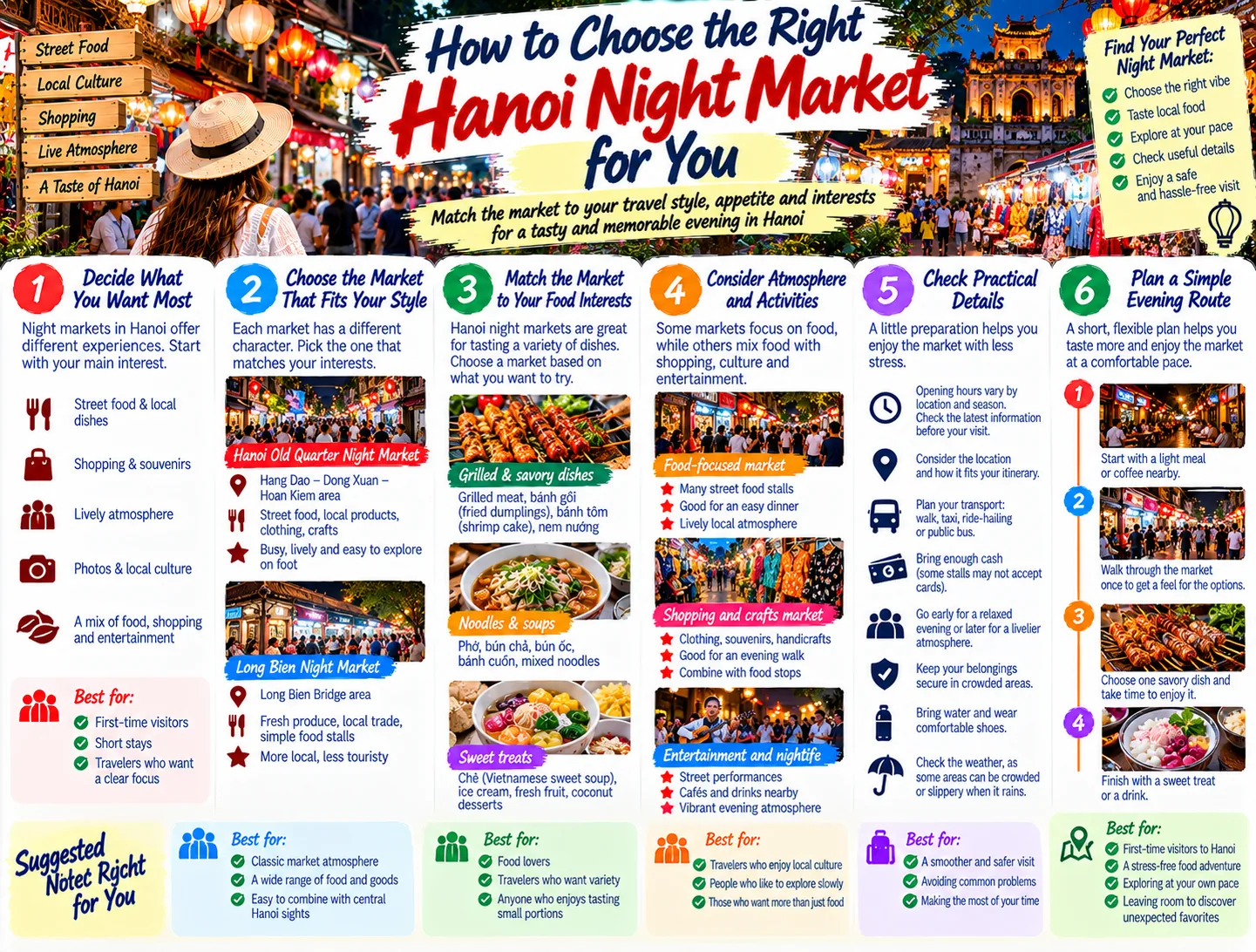
Hanoi’s markets are easiest to enjoy when you treat them as different kinds of eating places rather than one attraction to tick off. A covered produce market, a busy evening shopping street, and a neighborhood food lane each reward a different pace. This guide to Hanoi night markets helps you choose the right setting for your appetite, timing, comfort level, and curiosity, with practical ways to taste more and waste less time.
Start with the market experience you actually want
The phrase “Hanoi night market” often suggests one continuous food destination, but market evenings vary in mood and purpose. Some are best for browsing, some for small snacks between other plans, and some for seeing how everyday ingredients become dinner. Choosing by experience is more useful than chasing a universal ranking.
For a first taste of Hanoi street food
Pick a lively evening area where several stalls sit close together. This makes it easier to compare portions, watch food being assembled, and order two or three small items instead of committing to one large meal. It also suits first-time visitors who want familiar starting points such as grilled dishes, noodles, fried snacks, or a sweet dessert.
For ingredients and everyday shopping
Choose a traditional market earlier in the day, when the emphasis is more likely to be fresh produce, herbs, seafood, meat, and pantry goods than nightlife. These markets are useful for understanding the building blocks of Vietnamese cooking, even if you do not plan to buy ingredients. Go with observation in mind: notice how herbs are grouped, how vendors keep different foods separate, and how shoppers move through narrow aisles.
For atmosphere rather than a full meal
A pedestrian-friendly market street can be ideal when you already have dinner plans. Have one snack, take a slow walk, and leave room for a café or dessert stop. This approach is less stressful than trying to sample everything and gives you time to notice crafts, clothing, music, and the social rhythm around the stalls.
What to eat at Hanoi night markets
Build a market meal around contrast. Start with one savory item, add something fresh or herb-forward, then finish with a sweet or cooling dish. Hanoi’s official tourism food guide describes a broad street-food culture that goes beyond phở, bún chả, and bánh mì, including bánh cuốn, bún ốc, bánh tôm, bánh gối, and chè. That variety is exactly why markets work well for grazing rather than ordering a single course.
Begin with a manageable savory bite. Bánh gối, fried dumplings, or a small grilled snack can introduce texture without taking up your whole appetite.
Try a noodle or soup dish when you want substance. Look for a bowl that is being served steadily and appears suited to the time of day. Hanoi’s food traditions include both light noodle soups and more filling dishes.
Use herbs and sauces as part of the experience. Fresh herbs, lime, pickles, and dipping sauces are not decorative extras; they change the balance of a bite. Taste a little first, then adjust.
Save room for chè. Vietnamese sweet soup can include beans, jellies, fruit, glutinous elements, syrup, or coconut. It is an easy way to end a multi-stop walk.
For a broader dish-by-dish introduction before you go, read Traditional Vietnamese Dishes to Try in Hanoi. If you want the wider street-food vocabulary and ordering context, the site’s practical Hanoi street food guide is a useful companion.
How to choose a stall without overthinking it
Market eating rewards simple observation. You do not need to inspect every vendor or assume that the longest queue is automatically best. Instead, look for a stall that is busy enough to show regular turnover, organized enough for you to understand what is being served, and comfortable enough for you to make a clear order.
Use the three-minute check
Watch one order from start to finish. Can you see the ingredients, cooking method, and serving size?
Notice whether cooked food is handled separately from raw ingredients. If the setup is difficult to read, choose another stall.
Look for the vendor’s ordering rhythm. A calm, clear exchange is better than rushing into a dish you cannot identify.
Choose popular items that are being prepared in front of you when possible. This does not guarantee that a dish will suit your taste, but it makes the decision more transparent. Ask what an item contains if you have an allergy, avoid a food, or simply want to know whether a dish is sweet, spicy, sour, or rich.
Menus may be informal, and a pointing gesture can be enough, but clarity matters. Use a translation app or a photo when necessary, then confirm quantity and price before the food is prepared. If a stall cannot communicate the basics and you feel pressured, walk on. There will be another option nearby.
Plan your route around time, heat, and appetite
The best time for a market depends on what you want to see. Earlier visits are usually more useful for produce, ingredients, and everyday commerce. Later visits tend to suit snack-focused wandering and the atmosphere of an evening market. Exact opening times can change by location, season, weather, and local management, so verify the current schedule close to your visit rather than relying on an old blog post.
A practical one-evening sequence
Start with a light meal or coffee before entering the busiest area. Then walk once without buying anything. On the second pass, select one savory dish, pause somewhere that does not block the stall, and note what you still want to try. Finish with a dessert or a nearby sit-down meal. This sequence reduces impulse buying and leaves you enough attention to enjoy the surroundings.
If the weather is hot or humid, shorten the route and favor dishes that can be eaten promptly. If rain is possible, make a covered market or a nearby restaurant your anchor, with open-air stalls as optional stops. Hanoi’s food scene is flexible: a market visit does not have to be an endurance test to be worthwhile.
For a route that combines several kinds of eating stops, compare your plan with the site’s Hanoi food itinerary for first-time eaters. It can help you place a market visit between breakfast, coffee, and a more deliberate dinner.
Match the market to your travel style
Solo travelers
Solo visitors can move quickly and sample more widely, but a small order is still the safest way to manage unfamiliar food. Pick stalls where you can stand or sit without occupying a large table, and keep your route compact. A market is also a good place to practice ordering one item at a time rather than planning a full meal in advance.
Couples and friends
Share two or three dishes and compare preferences. One person can hold the route map while the other orders, but avoid splitting up in crowded lanes unless you have agreed on a meeting point. Markets are more enjoyable when the group leaves room for different appetites instead of making everyone eat the same thing.
Families
Visit earlier if children need more space and patience. Choose recognizable foods first, carry water, and avoid making the evening depend on one hard-to-find stall. A short market walk followed by a seated meal is often more comfortable than a long circuit through dense crowds.
Vegetarian travelers and diners with allergies
Do not assume that a dish is vegetarian because it contains vegetables. Broths, sauces, toppings, and cooking surfaces may include meat, seafood, eggs, or fish sauce. Explain your needs clearly and ask what can be left out. For more structured planning, see the site’s Vegetarian & Special Diets category, which offers a useful starting point for Hanoi dining decisions.
Market manners that make eating easier
Hanoi markets are working spaces as well as visitor experiences. Stand to the side while deciding, keep bags close, and do not photograph a vendor or customer at close range without permission. If a stall is crowded, order, collect your food, and move away from the serving area so others can be helped.
Use small bills or a payment method the vendor accepts, but do not assume every stall handles payments in the same way. Confirm the total before handing over money. Keep tissues and hand sanitizer available, especially when moving between several stalls, and be sensible about food that has been sitting out in uncertain conditions. Protective habits should be quiet and practical, not a reason to reject the whole market experience.
Markets can also be noisy and visually intense. Take a break when you need one. A café stop is not a failure to explore; it is often the best way to reset your senses before another short walk. The site’s Food Markets & Night Markets category is the natural place to continue comparing market-focused ideas and seasonal planning advice.
Look beyond the standard night-market checklist
Many guides reduce Hanoi markets to a list of names, dishes, and opening times. A better approach is to ask what the visit reveals. Can you see the ingredients behind a famous dish? Does the route show how snacks, coffee, and dinner connect? Is the market helping you understand a neighborhood, or are you simply moving through a crowded photo opportunity?
Official tourism coverage presents Hanoi food as regional, varied, and strongly visible in everyday street settings. That suggests a useful rule: do not measure a market only by the number of stalls. Measure it by how much it helps you taste the city’s range. One well-chosen bowl, a shared fried snack, and a dessert you had not planned to try can be a fuller experience than a rushed checklist.
Also check the official tourism events calendar before a date-specific trip. Hanoi’s 2026 tourism listings include a craft village and gastronomy festival running from October 1 through October 31, 2026, showing how food-related programming can be seasonal and time-bound. Treat event details as current information that needs rechecking, not as permanent market hours.
Build a flexible backup plan
A market visit works best when it is one part of an evening, not the only thing that can go right. Save a nearby café, restaurant, or quieter street as a fallback if a lane is too crowded, a stall has closed, or the weather turns. Keep one or two alternative dishes in mind, too. If a seafood snack is unavailable, you can still explore noodles, fried cakes, herbs, or chè without losing the purpose of the walk. Flexibility lets you stay curious instead of turning a temporary change into a travel disappointment.
Conclusion: make your Hanoi market visit your own
The best Hanoi night market strategy is simple: choose the atmosphere first, eat in small stages, watch how a stall works, and leave room for a dish that was not in your original plan. Use an earlier market visit for ingredients and context, an evening market for grazing and atmosphere, and a flexible route when weather or crowds change. With that approach, markets become more than places to buy snacks. They become an accessible way to understand Hanoi through flavor, movement, and ordinary daily life.
JOIN THE CONVERSATION
Comments (0)
No comments yet. Be the first to share a thought.