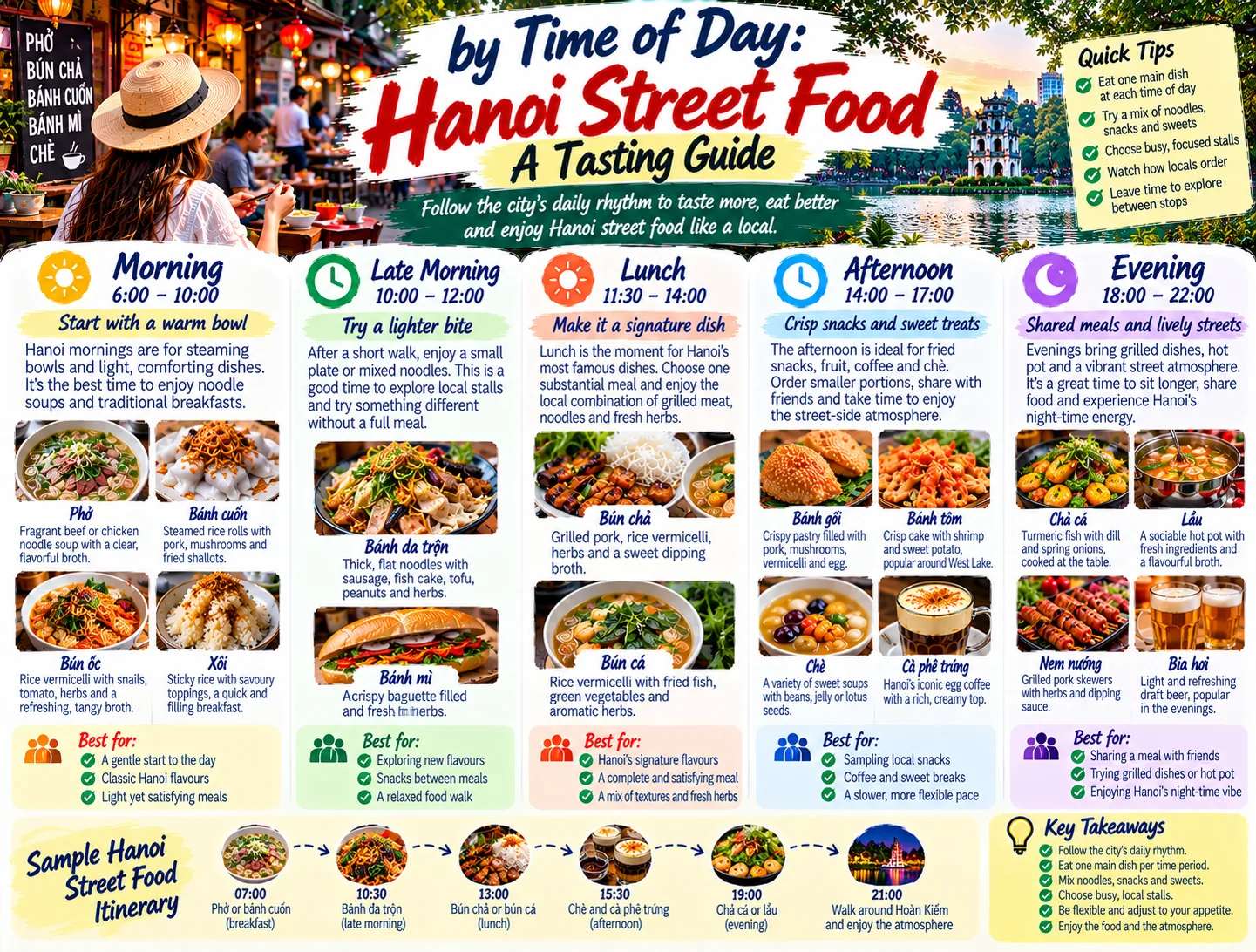
Hanoi street food is easiest to understand as a day-long rhythm rather than a checklist of famous dishes. Breakfast stalls open with steaming bowls, lunch brings quick noodle plates, afternoon turns to crisp snacks and sweet soups, and evening encourages a slower meal shared around a table. This guide helps you plan that rhythm without trying to eat everything at once. It focuses on what to look for at each part of the day, how to build a balanced food walk, and how to make confident choices when a menu or stall is unfamiliar.
Start with the shape of a Hanoi food day
A useful Hanoi street food itinerary has three qualities: variety, manageable portions, and enough time between stops. Instead of treating every dish as a full meal, alternate a substantial bowl with a smaller snack. That approach leaves room for regional flavours while keeping the walk enjoyable.
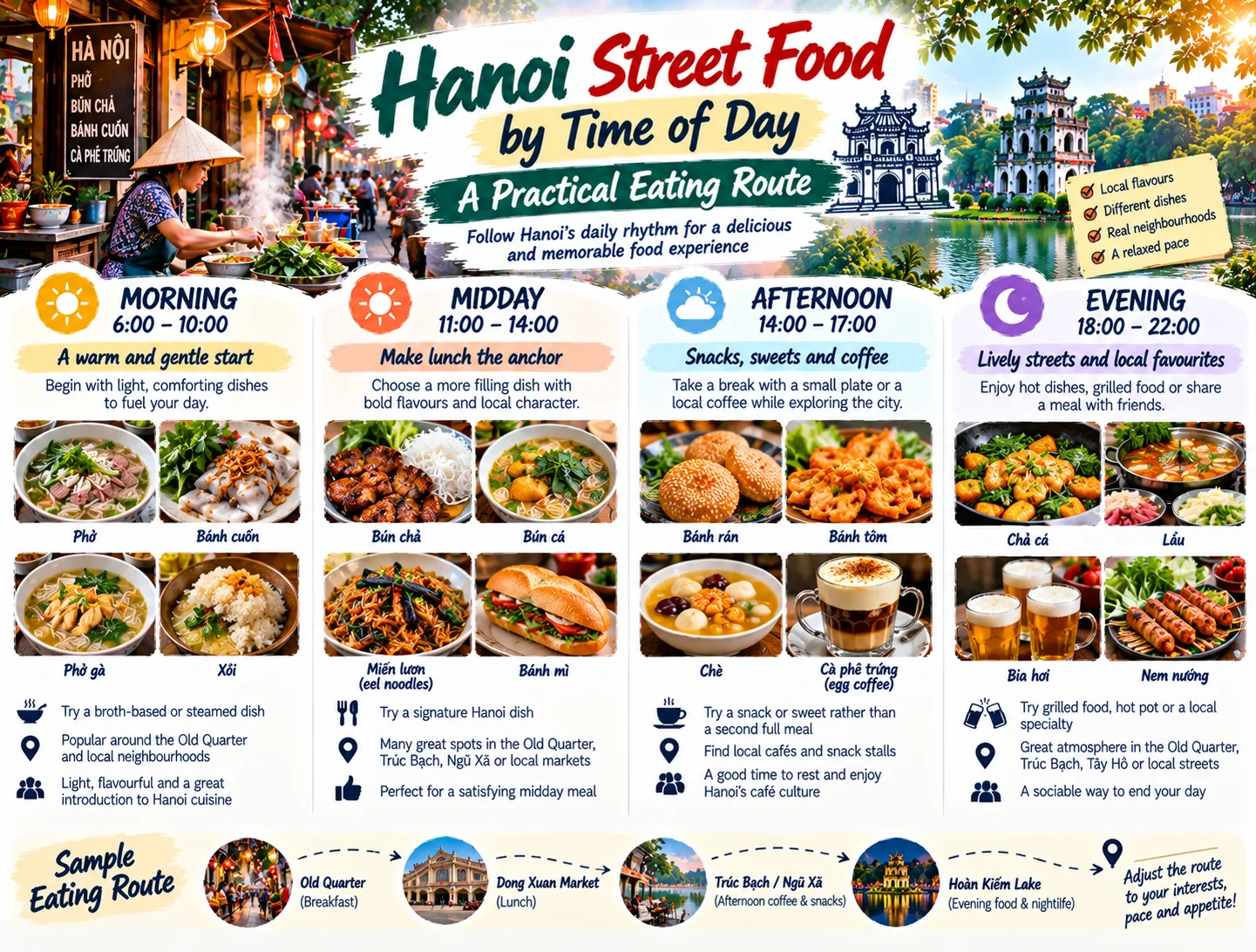
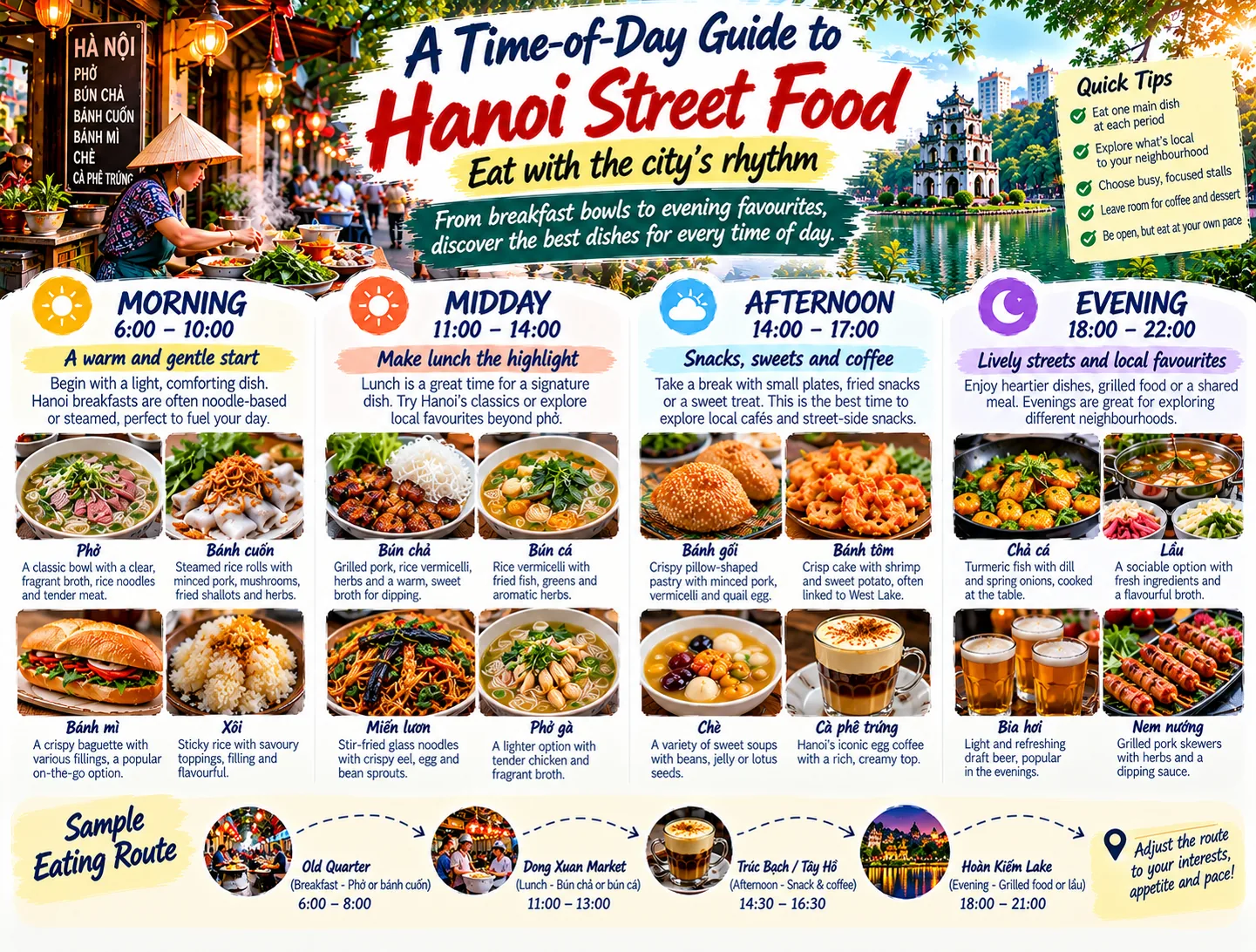
Morning is the best moment to seek dishes built around broth, rice batter, or noodles. Midday is practical: choose a dish that arrives quickly and can stand on its own. The afternoon is ideal for fried snacks, herbal dishes, or chè. At night, look for grilled food, hot pot, or a shared plate that gives you time to watch the street come alive.
For a broad introduction to ordering, neighbourhood choices, and classic dishes, pair this time-based plan with our practical Hanoi street food guide. The goal is not to follow a rigid route. It is to recognise the kind of meal that suits the hour, the weather, and your appetite.
Breakfast: choose a warm, focused bowl
Phở and bún as a first stop
Hanoi mornings naturally suit soup. Pho is the most familiar starting point, but it is not the only option. The official Vietnam Tourism guide describes bánh cuốn as a traditional breakfast in the capital: thin steamed rice rolls can be filled with pork, mushrooms, eggs, or a mixture, then served with fried shallots, herbs, and a sweet-and-sour fish sauce. It is a good choice when you want something lighter in texture than a large bowl of noodles.
Bún ốc is another morning possibility for adventurous eaters. Its rice vermicelli, snail, herbs, tomato, vinegar, and pepper create a sharper, more layered bowl than a plain broth. If you prefer a familiar entry point, choose phở; if you want to understand Hanoi beyond its headline dishes, use breakfast to try bánh cuốn or bún ốc.
How to order without overthinking
Decide whether you want beef, chicken, seafood, or a vegetarian option before sitting down.
Watch how local diners add herbs and condiments, then add a little at a time.
Keep breakfast to one main dish so you have room for later stops.
Breakfast is also a useful time to notice the structure of a street-side meal: a compact seating area, a focused menu, and ingredients prepared for a quick turnover. You do not need a long explanation to participate. Observe, point to what you want, and keep the transaction simple.
Late morning: follow the lighter noodle trail
After breakfast, a walk gives you time to digest and makes the next stop more interesting. If you are still hungry before lunch, look for a small serving rather than repeating another large soup. Mixed noodles, rice rolls, or a shared snack can bridge the gap.
Bánh đa trộn is particularly useful for this part of the day. Vietnam Tourism describes it as a Hanoi speciality built around thick, flat noodles with toppings such as sausage, fish cake, tofu, peanuts, and leafy vegetables; thin glass noodles may also be available. It is a textural dish, so take a moment to mix the bowl before eating. The combination of noodles, crunchy toppings, herbs, and savoury ingredients makes it feel substantial without following the same broth-based pattern as breakfast.
Use late morning to explore rather than chase a famous address. A stall that looks busy, focused, and well organised may be a better stop than a place chosen only because it appears on a generic list. For more help comparing sit-down venues with small local tables, see our guide to choosing restaurants in Hanoi.
Lunch: make room for Hanoi’s signature contrasts
Bún chả, phở, or bún cá?
Lunch is the moment for a dish with a clear centre of gravity. Bún chả brings grilled pork, rice vermicelli, herbs, and dipping sauce together in a format that is interactive but still easy to understand. Phở remains a reliable choice when you want a complete bowl. Bún cá, highlighted by Vietnam Tourism as a lunch dish, combines rice vermicelli with fried fish, green vegetables, and aromatic herbs such as coriander and dill.
Think about contrast when choosing. If breakfast was a clear broth, pick grilled meat or fried fish for lunch. If the morning meal was crisp or starchy, a herb-heavy noodle bowl may feel fresher. This simple rotation is more useful than trying to rank every Hanoi dish, because your enjoyment depends on what you have already eaten.
Build a balanced street-food lunch
Choose one main dish with protein or tofu.
Add herbs and vegetables as part of the meal, not as decoration.
Share an extra item if you want to compare styles without ordering two full portions.
Pause before ordering dessert; Hanoi’s food day has several sweet stopping points.
If your trip is short, a planned lunch can anchor the rest of your route. The site’s Traditional Vietnamese Dishes category is useful for comparing familiar classics with less obvious regional specialities before you set out.
Afternoon: explore crisp snacks and slow flavours
Fried snacks for a food walk
Afternoon is the best time to sample dishes that might be too rich as a full meal. Bánh tôm, associated in the official guide with West Lake, combines battered sweet potato and prawns with sweet-and-sour fish sauce and papaya. Bánh gối is a pastry filled with ingredients including minced pork, black fungus, vermicelli, and quail egg. Both work well as sharing dishes, especially when you want to keep walking.
Do not treat fried food as a test of endurance. Order one portion, share it, and notice the balance between crisp coating, filling, herbs, and dipping sauce. A small snack eaten while curious is more memorable than several heavy plates ordered without a plan.
Try a dish with a different texture
Miến xào lươn, or stir-fried glass noodles with eel, offers a different direction. The official guide describes versions with crispy eel, egg, bean sprouts, cucumber, and herbs, as well as eel porridge. It is a useful choice for travellers who have already tried the most recognisable noodle soups and want to explore a less expected ingredient.
Weather matters here. On a cool or rainy afternoon, a warm bowl of bánh đúc nóng can be more satisfying than a fried snack. Vietnam Tourism describes this soft rice-and-tapioca cake with fillings such as black fungus, meat, fried shallots, fish sauce, and herbs. On a hot day, save your appetite for chè instead.
Sweet breaks: finish a route with chè or coffee
Chè is not simply an afterthought. It gives a street-food walk a change of temperature, texture, and sweetness. Vietnam Tourism describes chè as a layered sweet soup that may include red bean, mung bean, glutinous rice balls, herbal jelly, syrup, and coconut. Because combinations vary, ask what is in the bowl if you have allergies or dislike a particular ingredient.
Hanoi coffee also fits naturally into the afternoon pause. A coffee stop lets you sit down, review what you have eaten, and decide whether dinner should be substantial or light. The city’s official tourism page lists egg coffee among Hanoi’s signature flavours, but coffee should complement the food walk rather than replace water and rest.
For a dedicated look at drinks, café etiquette, and the slower side of the city, browse the Hanoi Coffee Culture category. A good break is part of pacing: it prevents the day from becoming a sequence of rushed tastings.
Evening: share, linger, and follow the street’s energy
Choose a meal that rewards company
Evening is the time to move from individual bowls to shared plates. Hot pot, listed in the official street-food guide as a communal meal of broth, vegetables, meat, or seafood, rewards a slower pace. It also makes sense for a group because everyone can choose what to add. If you are travelling alone, look for grilled items, a smaller noodle dish, or a compact plate rather than ordering a large hot pot by yourself.
Hanoi’s street culture changes after dark. The city tourism page describes the Old Quarter as a maze of historic streets and points to weekend night markets as part of the visitor experience. That does not mean every night market is a food destination or that every stall operates on the same schedule. Treat the evening as an opportunity to walk, compare, and choose what is visibly active rather than relying on an assumed timetable.
Keep the final meal comfortable
Late in the day, familiar foods can be the right choice. A second serving of phở, a modest bánh mì, or a grilled dish may be more enjoyable than forcing yourself to try an unfamiliar speciality. If you want one final challenge, mỳ gà tần combines braised chicken, egg noodles, and aromatic herbs; the official guide presents it as hearty and distinctive. Order it because the flavour interests you, not because a checklist says you must.
How to plan a practical Hanoi street food walk
Start with a neighbourhood that lets you walk between several types of stop, then choose one anchor meal and two flexible pauses. Avoid promising yourself a precise number of dishes. Street stalls change, appetites change, and the best discovery may be the place that was not on your original list.
Use breakfast for soup or steamed rice rolls.
Use lunch for bún chả, bún cá, or another complete noodle dish.
Use the afternoon for one crisp snack and a sweet or coffee break.
Use dinner for a shared plate, hot pot, or a familiar meal.
Carry water and leave time to sit down between stops.
Before choosing a longer route, compare the site’s Hanoi Food Tours category with our practical guide to planning a Hanoi food walk. A guided experience can help when you want explanations, while a self-guided route works well when you prefer to stop whenever something catches your eye.
Questions to ask when a dish is unfamiliar
Curiosity is useful, but you do not need to pretend that every ingredient suits you. Ask whether a dish contains meat, seafood, egg, peanuts, or a strong herb. If you have a serious allergy or dietary restriction, communicate it clearly and confirm what the stall can safely provide; do not assume that removing one visible ingredient eliminates cross-contact.
You can also ask how a dish is normally eaten: mixed together, dipped, wrapped in herbs, or served with broth on the side. This is often more helpful than asking whether something is “spicy.” Start with a small amount of sauce, chilli, or fermented condiment, then adjust. The point of a Hanoi street-food experience is participation, not proving tolerance.
Conclusion: let the day guide your appetite
The best Hanoi street food plan is flexible but not random. Begin with a warm breakfast, use lunch for a signature contrast, keep the afternoon open for snacks and chè, and let dinner become slower and more social. By matching dishes to the time of day, you can taste widely without turning the city into a rushed eating challenge. Leave a little space for surprise: Hanoi’s most memorable meal may be the one that fits your walk, your weather, and your appetite in that exact moment.
JOIN THE CONVERSATION
Comments (0)
No comments yet. Be the first to share a thought.