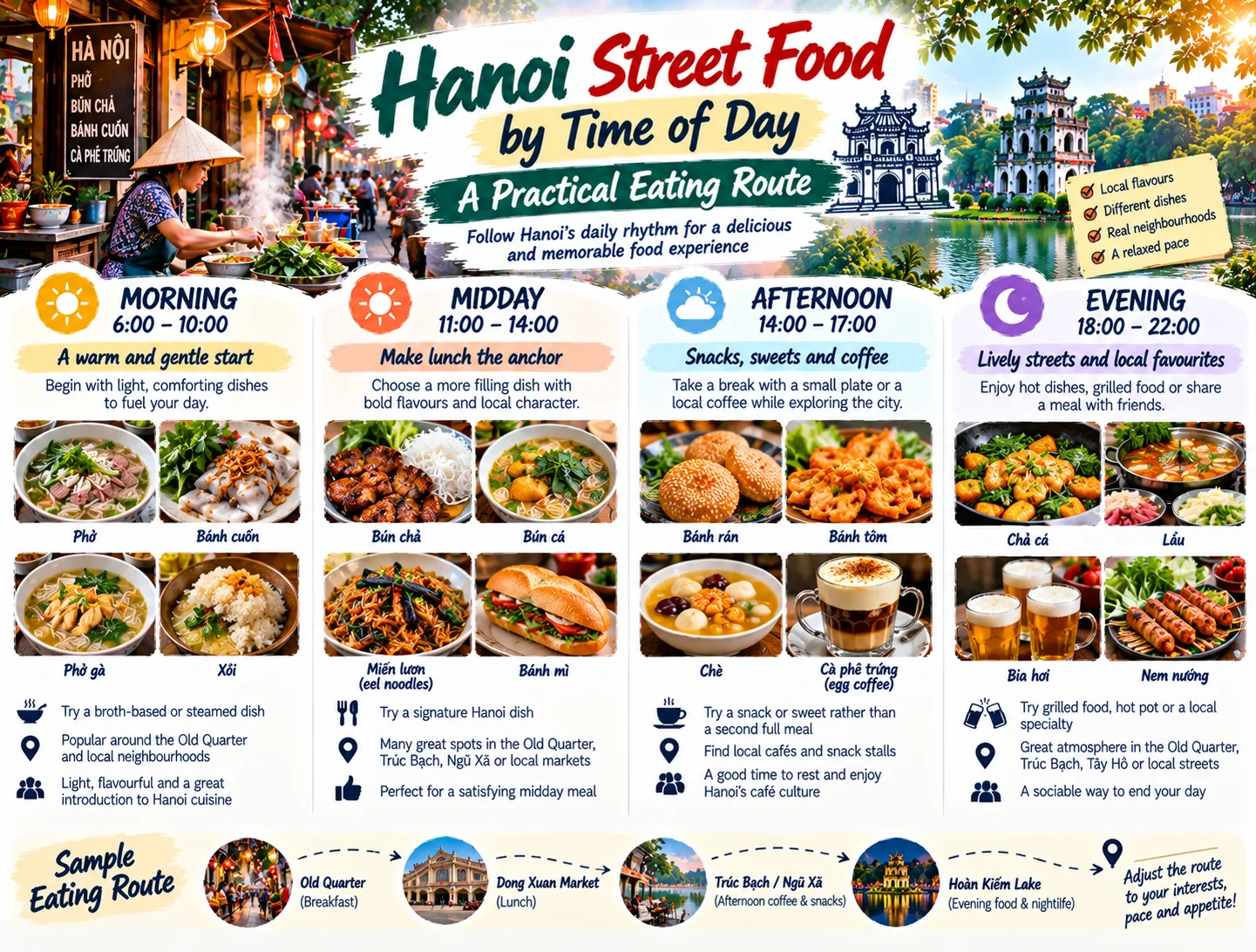
Hanoi street food is easiest to enjoy when you stop treating it as a checklist and start following the city’s daily rhythm. Breakfast stalls, noodle lunches, afternoon snacks, lakeside specialties and sociable evening tables each reveal a different side of the capital. This guide gives first-time visitors a practical way to plan what to eat, where to focus, and how to make room for lesser-known dishes without repeating the usual pho-and-banh-mi circuit.
Plan Hanoi street food around the clock
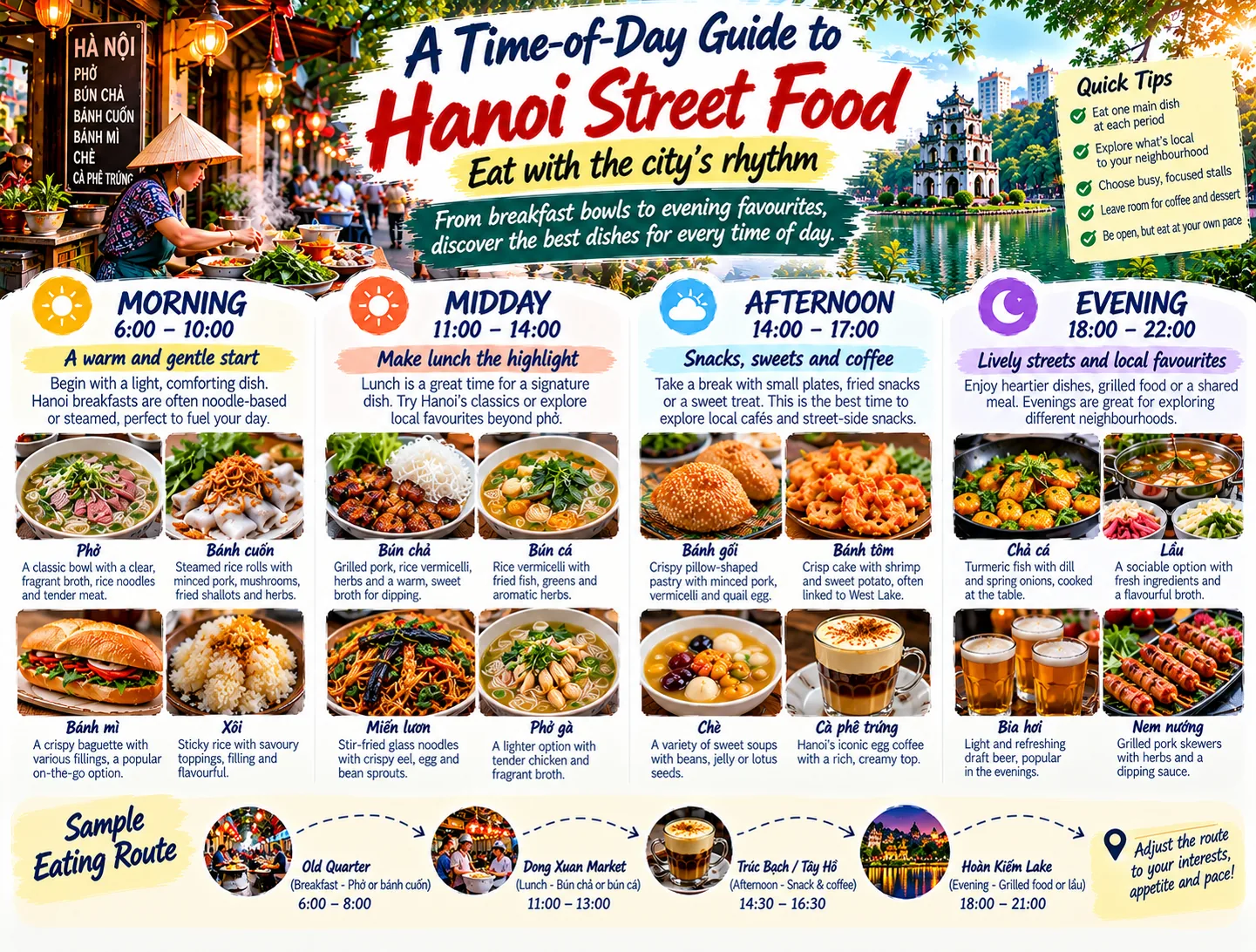
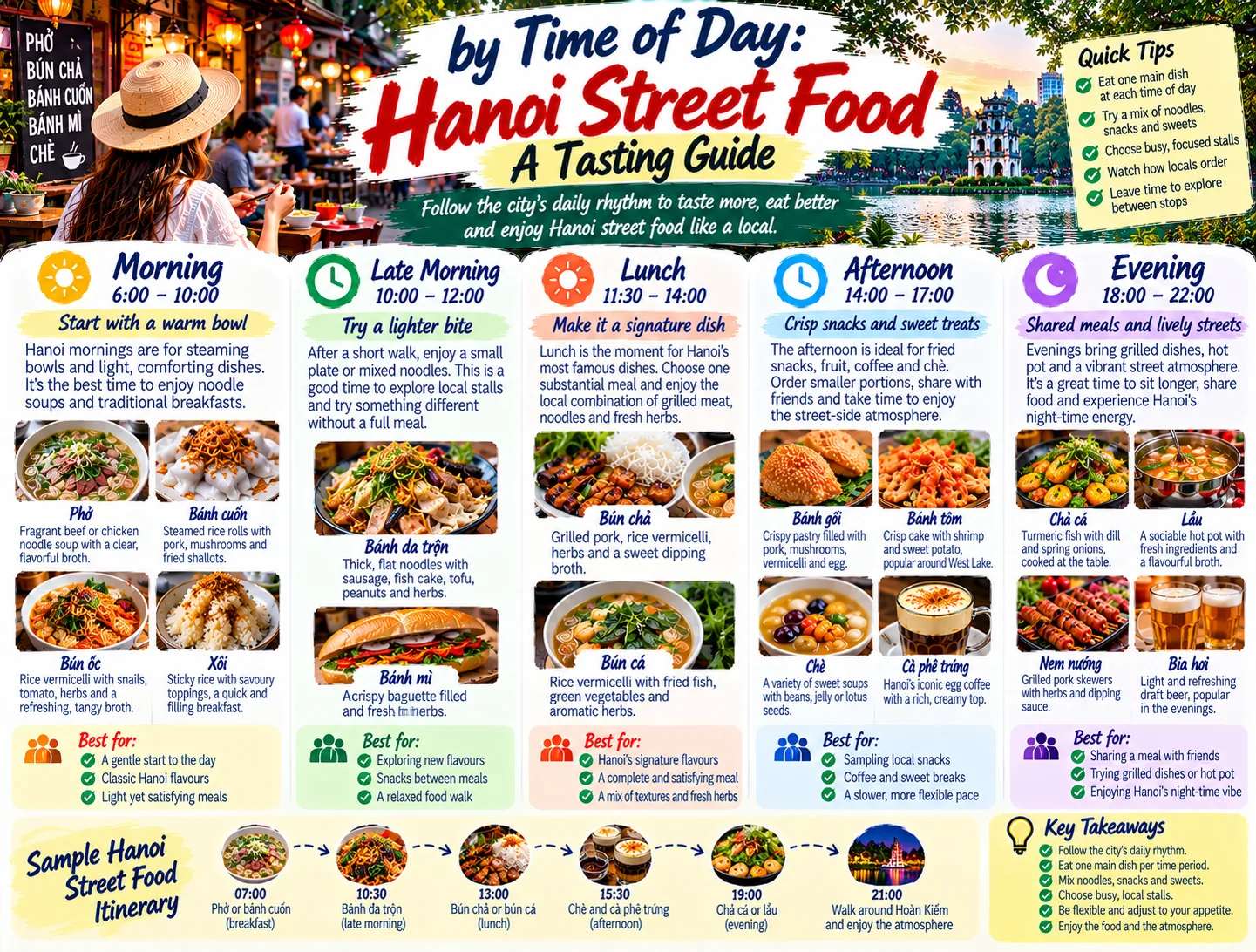
The best Hanoi street food itinerary is not necessarily the one with the most stops. It is the one that spaces out contrasting textures and flavours. Begin with a light, brothy or steamed breakfast, choose a filling lunch, leave room for a small afternoon plate, then finish with a dish designed for sharing. That rhythm helps you taste more while avoiding the common mistake of ordering three similar noodle bowls in a row.
Hanoi’s official tourism guide describes the city as a place where street culture and gastronomy are central to the experience, while its food guide stresses that Vietnamese cooking is strongly regional. In practical terms, that means a dish can be worth trying in Hanoi not because it is unfamiliar in Vietnam, but because the capital gives it a particular local setting and style.
Morning: choose steamed rice rolls, pho, or another warm bowl.
Midday: look for a complete meal such as bun cha, bun ca, or eel noodles.
Afternoon: share a fried snack, cake, or sweet soup rather than ordering a full second meal.
Evening: explore hot pot, grilled food, or a dish linked to a specific neighbourhood.
For a broader first-day framework, pair this article with the site’s practical Hanoi food itinerary. It helps place a street-food day inside a longer visit without turning every meal into a rushed food crawl.
Start with a Hanoi breakfast that is warm and balanced
Bánh cuốn for a gentle first meal
Bánh cuốn, or steamed rice rolls, is a useful introduction to Hanoi’s food logic: soft rice sheets, savoury filling, herbs, fried shallots and a sweet-sour fish sauce served together. The official Vietnam Tourism food guide lists versions filled with minced pork, mushrooms, eggs or combinations of these ingredients. Because the dish is delicate rather than heavily fried, it works well when you want to begin a full day of eating without feeling overloaded.
Eat it slowly and notice the contrast between the tender roll, crisp shallot and fresh herbs. If you are unsure about a sauce or filling, ask before ordering. A simple question about ingredients is more useful than assuming every plate follows the same recipe.
Pho when you want a classic bowl
Pho remains one of Hanoi’s defining foods, but it does not have to be the only answer to the question of what to eat in Hanoi. Choose it when you want a focused, aromatic bowl and a meal that can stand on its own. The city’s official destination page identifies pho Hanoi as a signature flavour, alongside bun cha, banh mi, cha ca, egg coffee and bia hoi.
Visitors who want a deeper overview can continue to the site’s guide to traditional Vietnamese dishes in Hanoi. Use that guide to compare the classics, then reserve this street-food article for planning a varied day rather than repeating the same famous dish at every stop.
Make lunch the anchor of your street-food day
Bun cha for the charcoal-and-herb contrast
Bun cha is one of the strongest choices for a midday anchor. The dish combines grilled pork, rice vermicelli, herbs and a warm dipping sauce, creating a meal that feels more layered than a single bowl of noodles. Add noodles, herbs and pork in changing proportions so each bite tastes different. It is also a practical choice for sharing: one person can focus on the grilled meat while another samples the herbs and sauce.
Try bun ca or eel noodles when you want something less obvious
The official Hanoi food guide highlights bun ca, a rice-vermicelli soup with fried fish and aromatic herbs that can include coriander and dill. It also describes miến xào lươn, stir-fried glass noodles with crispy eel, egg and bean sprouts, along with other eel preparations. These are useful alternatives when you have already eaten pho or want to explore beyond the most internationally familiar Hanoi local dishes.
Think of lunch as the moment to test a dish with a more distinctive ingredient. If eel or fish is not appealing, do not force the experiment; Hanoi has enough variety to let you choose another route. The goal is curiosity, not culinary endurance.
Use neighbourhoods to shape the route
Old Quarter for variety and short walking links
The Old Quarter is convenient for a first Hanoi street food guide because many experiences can be connected on foot, but convenience should not be confused with a guarantee that every stall suits every visitor. Walk with a flexible plan, compare the pace of different streets, and choose places where the menu and preparation are easy for you to understand.
The official Hanoi walking guide describes routes through Hoan Kiem, local markets and the Old Quarter, with street-side food appearing alongside cafés, bridges and historic streets. Its market route includes Dong Xuan Market and leads toward Long Bien Bridge, making it a useful model for combining food with a walk rather than treating eating as an isolated activity.
Truc Bach and Ngu Xa for a food-focused detour
For a more specific neighbourhood angle, follow the route toward Truc Bach Lake and Ngu Xa. Vietnam Tourism calls Ngu Xa a famous foodie area and names pho cuon, fresh rice noodle rolls with grilled pork, and pho chien phong, fried rice-noodle squares served with rich gravy, beef and vegetables. These dishes give you a clear reason to leave the central Old Quarter for a short, food-led detour.
Use the site’s Hanoi Street Food category for more focused local eating ideas, and browse the Food Markets & Night Markets category when you want to combine snacks with market atmosphere.
Leave room for Hanoi’s afternoon snacks
Fried snacks for sharing
Afternoon is the right time to sample smaller plates. Bánh gối, a crisp pillow-shaped pastry filled with ingredients such as minced pork, black fungus, vermicelli and quail egg, is one option described by the official food guide. Bánh tôm, associated with the West Lake area, pairs battered sweet potato and prawns with a sweet-sour sauce and papaya. Order one plate for the table and treat it as a texture break between larger meals.
These snacks are also a reminder that “street food” does not mean one fixed format. A carrying pole and two baskets, a tiny counter, a lakeside table or a busy market lane can all be part of the experience. Focus on what is being prepared in front of you and on whether the setting feels comfortable for your group.
Chè for a sweet finish
Chè, or sweet dessert soup, offers a colourful ending built from layers such as beans, glutinous rice balls, jelly, syrup and coconut. It is an especially useful choice when you want to taste something distinctive without ordering another savoury meal. Share a serving if you are still full; the point is to finish with a different flavour profile.
Build an evening around sociable dishes
Hot pot when you are travelling with company
Vietnamese hot pot is naturally social: a bubbling pot sits at the centre while diners add vegetables, meat or seafood according to preference. The official food guide presents it as a lively street-food experience and notes that it can become a communal meal. It is a good evening choice for families or friends who want to eat slowly and talk, rather than move between several quick stops.
Ask how the dish is served before ordering, especially if your group has different dietary needs. Confirm the base, the ingredients available, and whether separate cooking arrangements are possible. Treat these as normal planning questions, not assumptions about what a kitchen can provide.
Cha ca and the pleasure of one focused plate
Cha ca, turmeric-marinated fish served with dill, spring onions, peanuts and vermicelli, appears on Hanoi’s official destination guide as a signature flavour. It is a useful choice when you want a dish with a clear identity and a meal that feels more deliberate than grazing. If your schedule is short, place it on an evening when you can sit down and appreciate the preparation rather than trying to fit it between attractions.
Order thoughtfully when you are new to Hanoi
Use a three-question method
You do not need fluent Vietnamese to order street food, but you do need a way to make your needs clear. Before sitting down, establish three things: what the dish contains, how large the portion is, and whether the kitchen can adjust an ingredient. Pointing to a displayed dish or using the menu name can reduce confusion. For allergies, state the specific ingredient and ask whether cross-contact can be avoided; if the answer is unclear, choose another dish.
Vegetarians and travellers with dietary restrictions should plan with the same care. The site’s Vegetarian & Special Diets category is a useful next step for questions about meat-free eating, substitutions and how to communicate preferences.
Choose variety over volume
A practical Hanoi street food itinerary might include one breakfast, one substantial lunch, two shared snacks and one evening dish. That is enough structure to taste widely without treating the city like a competition. Keep a note of favourites, but do not feel obliged to finish every planned stop if a meal is more filling than expected.
For restaurant-selection principles that complement street stalls, see how to choose restaurants in Hanoi. The same basics apply: look for a menu you understand, a setting where you feel comfortable, and a meal that fits the pace of your day.
A simple one-day Hanoi street food itinerary
Start with bánh cuốn or pho in the morning. Walk around Hoan Kiem and the Old Quarter, then make lunch your main decision: bun cha for the signature charcoal-and-herb combination, bun ca for fish and herbs, or eel noodles for a more adventurous plate. In the afternoon, share bánh gối or bánh tôm, then choose chè if you want something sweet.
For the evening, decide whether your group wants a communal hot pot or a focused dish such as cha ca. If you still have energy, use the official walking route through markets or toward Truc Bach as inspiration, but keep the route adaptable. Streets, weather, appetite and group energy matter more than completing a rigid checklist.
Conclusion: eat Hanoi street food at the city’s pace
The most rewarding Hanoi street food experience balances famous dishes with regional specialties, planned meals with spontaneous snacks, and central streets with one or two purposeful neighbourhood detours. Start lightly, make lunch your anchor, share afternoon plates, and ask clear questions when a dish or ingredient is unfamiliar. That approach gives first-time visitors a practical route through Hanoi’s food culture while leaving enough room for the unexpected bowl, basket or table that becomes the meal they remember.
JOIN THE CONVERSATION
Comments (0)
No comments yet. Be the first to share a thought.