A Hanoi cooking class is more than a recipe lesson. At its best, it is a practical way to understand how the city shops, seasons ingredients, balances flavours, and gathers around food. The right class can turn a short visit into a skill you remember at home, but the wrong one may feel rushed, overly touristy, or poorly suited to your diet and confidence in the kitchen. This guide explains how to choose a Hanoi cooking class for beginners, what a useful workshop should include, and which questions to ask before reserving a place.
Start with the kind of experience you want
Search results often use “Hanoi cooking class” to describe very different formats. Before comparing menus or photographs, decide what you want to learn. A hands-on workshop is best if you want to chop, season, roll, and cook under a teacher’s guidance. A demonstration class suits travellers who prefer to watch, take notes, and concentrate on tasting. A market-to-table experience adds a shopping walk, while a private lesson gives you more room to ask questions or adapt dishes.
Think about the memory you want to take home. Some visitors want a reliable Vietnamese dinner they can recreate. Others care more about meeting a local cook, learning the names of herbs, or seeing how a familiar street-food dish is assembled. If you are still deciding how a class fits into your itinerary, the site’s Cooking Classes & Workshops category is a useful starting point for comparing formats and expectations.
Choose hands-on time over a long menu
A class that promises many dishes may sound generous, but a shorter menu often creates a better lesson. Beginners need time to understand knife work, heat, texture, and seasoning. Ask how many participants share each cooking station, whether everyone prepares a portion, and how much of the meal is cooked by the instructor. A class is genuinely hands-on when you make meaningful decisions rather than simply garnish food that somebody else has prepared.
Look for a menu that teaches Hanoi, not just Vietnam
Vietnamese food is wonderfully varied, and a Hanoi workshop should explain the northern character of its menu rather than treating every dish as interchangeable. Hanoi is strongly associated with dishes such as phở and bún chả, while fresh herbs, rice products, dipping sauces, pickles, and clear contrasts between savoury, sweet, sour, and spicy flavours appear across the table. A good teacher explains why an ingredient is used and what can be substituted outside Vietnam.
Do not judge a class only by whether it includes the dish you already know. The most useful menu may pair one recognisable preparation with a technique you have not tried: building a balanced dipping sauce, working with rice paper, preparing herbs, or controlling a hot pan. For background before you book, read the site’s guide to traditional Vietnamese dishes to try in Hanoi. It can help you identify whether a proposed menu feels connected to the city’s everyday food culture.
Ask how the menu changes with the season
Seasonality matters in a market-led cuisine. A responsible provider should be able to explain when a particular herb, vegetable, or fruit is easiest to find and what happens if availability changes. That does not mean the class needs to promise a fixed menu months in advance. Flexibility can be a strength when it is explained clearly and when substitutions preserve the dish’s purpose.
Decide whether a market visit is right for you
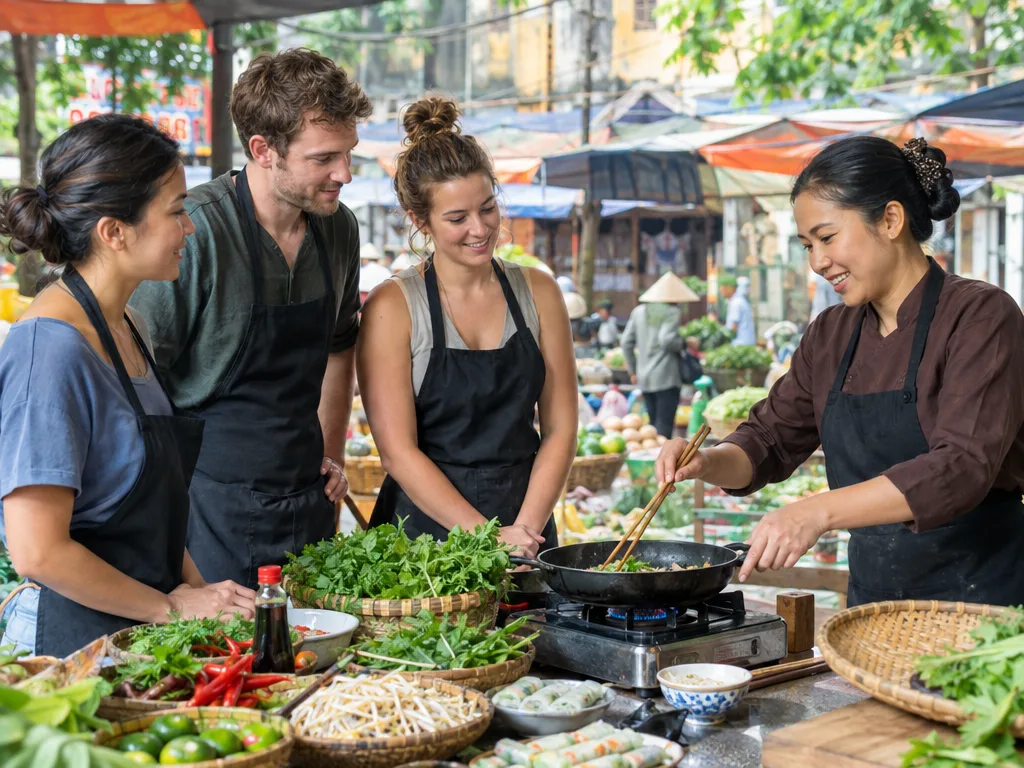
A market visit can make a cooking lesson more memorable because it connects a finished dish with the ingredients that built it. You may learn how local cooks choose herbs, distinguish similar vegetables, or think about freshness and texture. It can also make unfamiliar vocabulary less intimidating: seeing an ingredient, hearing its Vietnamese name, and using it in class creates a useful chain of associations.
However, a market walk is not automatically better. It may add travel time without adding much teaching, particularly if the group is large or the visit is mainly a shopping stop. Ask whether the instructor leads the walk, whether you will handle or taste ingredients, and whether the market portion has a clear learning purpose. Also ask about the walking surface, heat, rain plans, and how the group returns to the kitchen.
For a broader sense of how food fits into the city’s neighbourhoods, compare the class with the site’s Food Markets & Night Markets category. You can also read the practical Hanoi street-food guide before choosing a workshop that includes a market or street-food discussion.
Check the teaching style and group size
The instructor is the centre of the experience. Look for a teacher who explains the reason behind a step, watches participants work, and welcomes questions. A confident local cook does not need to turn the class into a lecture; the best teaching is often a sequence of short explanations followed by your own practice.
Group size affects how much guidance you receive. In a large group, the atmosphere may be lively and social, but you may wait for equipment or struggle to hear instructions. A small class can offer more personal correction and easier discussion, while a private lesson is useful for families, serious home cooks, or travellers with complex dietary needs. Ask whether the stated group size is the maximum, the usual number, or a marketing description that changes by date.
Questions worth asking before you book
- How long is the hands-on cooking portion?
- Does each guest cook, or does the instructor demonstrate most steps?
- How many people share a station, stove, or cutting board?
- Is the menu fixed, seasonal, or chosen on the day?
- Can the teacher explain ingredients and techniques in clear English?
- Will recipes be provided in a form that is easy to use at home?
These questions reveal more than a polished activity description. They also help you compare a short introductory workshop with a deeper class without assuming that the more expensive or longer option is automatically better.
Match the class to your diet and comfort level
Dietary communication should happen before payment, not when the first plate reaches the table. Tell the provider about vegetarian, vegan, halal, gluten-free, allergy-related, or other requirements and ask what can realistically be changed. “Vegetarian” can mean different things in different kitchens, especially when broths, sauces, fish sauce, shrimp paste, or shared utensils are involved.
Ask specific questions rather than relying on a broad promise. Is the stock vegetarian? Are sauces prepared separately? Will a substitute be cooked on a separate surface? Can the class avoid peanuts or other allergens, and how is cross-contact handled? If the answer is vague, choose a provider that communicates more clearly. The site’s Vegetarian & Special Diets category can help you continue planning food experiences that fit your needs.
Your confidence level matters too. Beginners may want help with a knife, a mortar and pestle, or a hot wok. More experienced cooks may prefer a class that focuses on regional flavour, fermentation, broth, or presentation. Be honest about what you can comfortably do in a busy kitchen. A good instructor can make a dish approachable without removing the interesting parts.
Plan the timing around your Hanoi itinerary
Cooking classes reward an unhurried schedule. Leave enough time to arrive, settle in, visit a market if included, cook, eat, and ask questions. A class placed between two tightly timed attractions can turn an enjoyable lesson into a source of stress. If the activity begins early, confirm where and when you should meet, especially if the route involves a market or a pickup point.
Consider your energy and appetite. A morning class may pair naturally with a market visit and a shared lunch. An afternoon workshop can be comfortable after a quieter morning, while an evening lesson may feel social but compete with a food tour or restaurant reservation. The right choice depends less on a universal “best time” than on how the session fits your own day.
For help building the rest of your food plans, browse the Hanoi Food Guides category and the site’s practical Hanoi food itinerary. Use those resources to leave breathing room rather than stacking every meal and activity into one route.
Evaluate what you will take home
A successful class should continue helping you after the holiday. Ask whether the provider supplies written recipes, ingredient names, measurements, substitution notes, and a short explanation of the techniques used. A recipe that lists “herbs” or “seasoning” without detail may be difficult to reproduce. The most useful handout explains texture and taste as well as quantities.
Look for guidance that acknowledges the reality of a home kitchen. You may not have the same burner strength, mortar, fish sauce, rice paper, or fresh herbs. A good recipe tells you what must stay authentic, what can be adapted, and how to recognise doneness without relying on a precise piece of equipment. If the provider shares recipes digitally, confirm when they will be delivered and whether the language is clear enough to follow later.
Also notice whether the class leaves time for reflection. Ask the teacher which dish is easiest to repeat, which technique deserves more practice, and where to find comparable ingredients at home. Those small conversations often provide more lasting value than an extra item added to the menu.
Read reviews for evidence, not just enthusiasm
Reviews are most useful when they describe what actually happened. Look for comments about the instructor’s explanations, the balance between demonstration and participation, the clarity of dietary communication, the condition of the kitchen, and whether the advertised menu matched the experience. Repeated details are more informative than a long list of five-star reactions with no specifics.
Be cautious with reviews that focus only on transport, photographs, or the amount of food. Those elements can matter, but they do not tell you whether you learned anything. Likewise, a complaint about a dish being unfamiliar is not necessarily a flaw in a Vietnamese cooking class. Read the review in context and compare it with your own priorities.
It is also sensible to check the cancellation and rescheduling terms before booking, especially if your travel dates are changeable. Policies can differ, and they may change, so treat the provider’s current written terms as the source of truth rather than relying on an old review.
A simple checklist for choosing your class
Before you reserve, run through this short checklist:
- Does the class teach a menu that interests you and reflects Hanoi?
- Will you perform enough hands-on work to justify the format?
- Is the group size comfortable for the level of guidance you want?
- Are market visits, meeting points, and timing explained clearly?
- Has the provider answered your dietary questions precisely?
- Will you receive recipes and practical substitution advice?
- Are the current booking, cancellation, and rescheduling terms easy to find?
If most answers are clear, you are probably comparing meaningful differences rather than marketing language. If several answers remain vague, keep looking. Hanoi has enough food experiences that you do not need to settle for a workshop that cannot explain what it actually offers.
Make the most of the lesson
Arrive ready to participate rather than to perform perfectly. Ask the teacher to repeat unfamiliar words, taste sauces at different stages, and notice how small changes affect balance. Pay attention to the order in which ingredients enter the pan, the way herbs are prepared, and the point at which a texture changes. These observations are often more transferable than memorising a recipe line by line.
Take notes in your own language and record questions while you work. If photography is allowed, use it to document ingredients or a technique, but do not let your phone replace attention. Share the meal slowly and ask how local diners would serve or adapt it. A cooking class becomes much more valuable when it opens a conversation about everyday food rather than ending at the final plate.
Conclusion
The best Hanoi cooking class for beginners is not necessarily the longest, cheapest, or most heavily advertised. It is the one with a clear format, a thoughtful menu, patient instruction, honest dietary communication, and enough hands-on time to build confidence. Decide what you want to learn, ask practical questions before booking, and choose a workshop that connects its recipes to Hanoi’s markets and daily food culture. You will leave with more than a meal: you will have a method for noticing how the city cooks.
JOIN THE CONVERSATION
Comments (0)
No comments yet. Be the first to share a thought.