To understand Hanoi Tet food traditions, look beyond the dishes themselves. The Lunar New Year table is a calendar, a family album, and a set of good wishes served in edible form. In Hanoi, preparations begin before the holiday arrives: homes are cleaned, markets fill with seasonal ingredients, and relatives decide which foods must be prepared for the altar, the family meal, or visiting guests. A bowl of soup, a plate of boiled chicken, or a square of bánh chưng can carry memories as clearly as any photograph.
This guide explains what appears on a traditional northern Vietnamese New Year table, why those foods matter, and how a visitor can experience the customs respectfully. If you are still learning the wider food scene, pair it with this introduction to Hanoi food traditions and the practical advice in the Traditional Vietnamese Dishes category.
Why food matters so much at Tết in Hanoi
Tết Nguyên Đán is the most important annual celebration in Vietnamese culture. It marks the beginning of a new year in the Vietnamese lunisolar calendar and brings together ideas of renewal, gratitude, prosperity, and family continuity. Food gives those ideas a physical form. Ingredients are bought carefully, dishes are arranged deliberately, and cooking becomes a shared activity rather than a task completed by one person.
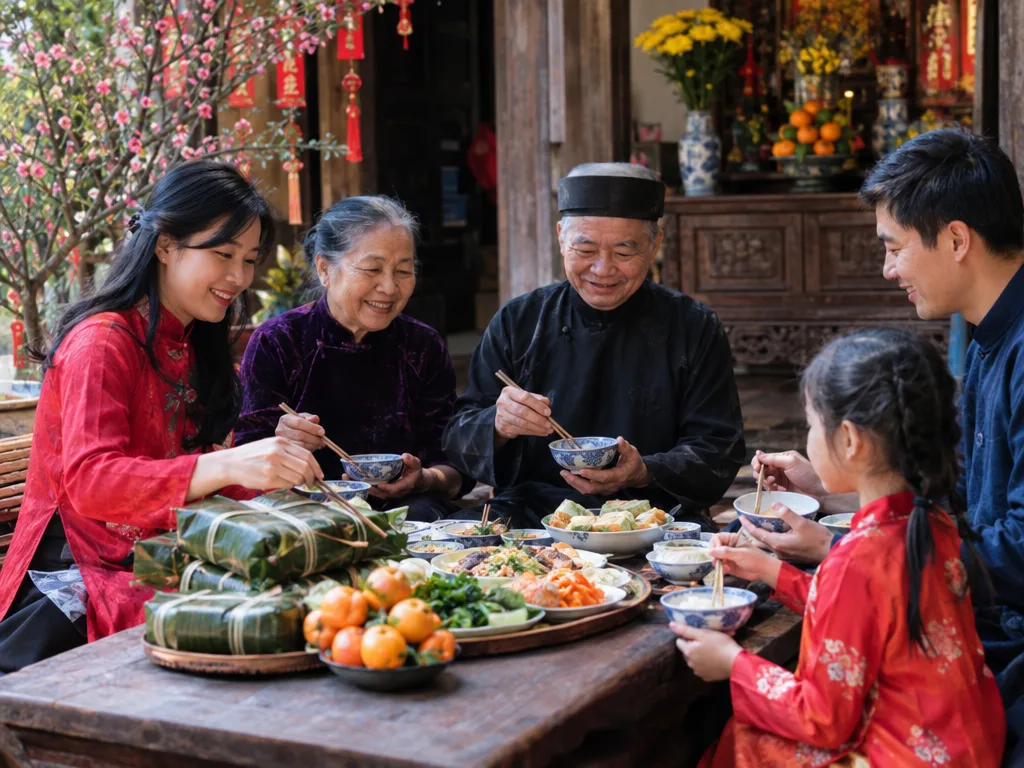
In a Hanoi household, the holiday meal often connects three generations. Older relatives remember how a dish was prepared in their childhood. Parents organize the shopping and cooking. Children learn names, gestures, and table manners by watching. The result is not a fixed restaurant menu: families adapt recipes, buy some foods ready-made, and add regional or personal favourites. What remains consistent is the intention to begin the year with abundance, harmony, and respect.
The holiday also has a rhythm. Preparations intensify from the final days of the lunar year, the family gathers for a year-end meal, and the first days of the new year are shaped by visits, greetings, offerings, and shared plates. That rhythm is useful for visitors because it explains why a food experience around Tết can feel more ceremonial than an ordinary Hanoi meal.
The northern centerpiece: bánh chưng
For northern Vietnam, bánh chưng is the food most closely associated with Tết. It is a square glutinous rice cake traditionally made with sticky rice, mung bean, and pork, wrapped in lá dong leaves and boiled until the ingredients become a compact, fragrant cake. Its square shape is commonly understood as a symbol of the earth, and its ingredients represent the agricultural foundation of a celebratory meal.
Making bánh chưng is as important as eating it. Families measure rice, soak ingredients, prepare the filling, fold the leaves, and tie each cake tightly before placing it in a large pot. In some households, several families share the work and keep watch over the pot for hours. The long cooking time turns preparation into a social occasion: people talk, children observe, and snacks may be roasted nearby while everyone waits.
The cake is practical as well as symbolic. Once cooked, it keeps well and can be sliced into portions for family meals or offered to guests. In Hanoi, you may see it on a family altar, at a market stall, or on a dining table with pickled vegetables and other savoury dishes. It is also a reminder that traditional food is not only about flavour. Texture, shape, labour, and timing all contribute to its meaning.
How to eat bánh chưng respectfully
If you are invited to share bánh chưng, follow the host’s lead. It may be served in neat slices, pan-fried after chilling, or accompanied by pickled onions and other savoury foods. Avoid treating it as a novelty to be dissected in front of the family. Asking who made it and when it was prepared is a warmer way to show interest, especially if the conversation turns to the family’s own Tết memories.
The year-end feast and the family altar
One of the most meaningful Hanoi Tet food traditions is the year-end meal, often called the tất niên feast. It is prepared near the close of the lunar year, when family members gather to mark the end of the old year and welcome the new one. A portion may be presented to ancestors before the family eats, reflecting the idea that absent or departed family members remain part of the celebration.
A traditional northern-style tray can include boiled chicken, giò lụa or another type of Vietnamese sausage, a soup, a vegetable dish, noodles, and other foods chosen by the household. The exact arrangement varies. Some families cook a generous multi-dish meal; others keep it simpler because modern schedules and smaller kitchens make elaborate preparation difficult. The important point is the gathering and the act of offering care through food.
In older accounts of Hanoi Tết, the final days of the year involved substantial shopping and preparation because markets and shops could close during the holiday. Contemporary life is more flexible, but the emotional logic survives. A stocked kitchen signals readiness, while a carefully arranged tray tells the family that the new year deserves attention.
Visitors should remember that an altar offering is not simply a decorative display. It is part of a family ritual. Wait until your host invites you to approach, and do not touch offerings, incense, or ceremonial objects without permission. If you are eating at a restaurant during the season, you can still observe the same values in a less formal way: dishes are shared, elders are served first, and the meal is treated as time together.
Five-fruit trays, flowers, and lucky colours
The mâm ngũ quả, or five-fruit tray, is another familiar feature of Vietnamese Tết. In northern homes, it may include bananas, a pomelo, kumquats, oranges, or other seasonal fruit. The exact combination is not universal, and meanings can differ by region and family. The tray is valued for its colour, abundance, fragrance, and the good wishes attached to it.
Fruit is placed on the altar or in a prominent part of the home rather than treated as an ordinary dessert bowl. Its presence suggests fruitfulness and prosperity, while the visual arrangement adds to the feeling that the house has been renewed for the new year. In Hanoi, the display often sits alongside peach blossoms, kumquat trees, calligraphic decorations, or other seasonal symbols.
Food and flowers work together during Tết. The red, gold, green, and pink tones of the holiday are not accidental; they create an atmosphere of energy and hope. When you visit a market in the days before Tết, notice how vendors sell ingredients, fruit, flowers, cookware, and decorative objects in the same seasonal flow. The market is part of the tradition because preparation begins with choosing what will enter the home.
If you want to explore the shopping side of the season, the site’s Food Markets & Night Markets category offers useful context for understanding Hanoi’s market culture. For a broader view of how a meal fits into a day of eating, see the practical Hanoi food itinerary.
Pickles, soups, and balance on the table
A Tết meal is not only a collection of rich centrepieces. Northern Vietnamese families often balance sticky rice, meat, and celebratory dishes with sharper, lighter, or more aromatic accompaniments. Pickled onions are a classic example. Their crisp texture and sourness help cut through the richness of bánh chưng and other savoury foods, making the meal easier to enjoy over several days.
Soups and vegetables also bring contrast. A family may serve a clear or gently seasoned soup, stir-fried greens, bamboo shoot soup, or another dish associated with its own household. These foods demonstrate an important principle in Vietnamese cooking: a satisfying meal depends on harmony among textures, temperatures, colours, and flavours rather than on one dominant dish.
This is why asking, “What is the most famous Tết dish?” gives only part of the answer. The more useful question is how the dishes work together. Sticky rice provides substance, pickles refresh the palate, soup softens the meal, and fruit closes or punctuates the gathering. The menu is a small expression of Vietnamese food culture, where balance matters as much as individual ingredients.
Regional differences to keep in mind
Bánh chưng is strongly associated with northern Vietnam, while bánh tét is more common in central and southern traditions. Families in different regions also choose different soups, sweets, vegetables, fruits, and ceremonial foods. Even within Hanoi, household practice can vary according to origin, religion, age, and family history.
Do not assume that one family’s Tết table represents all of Vietnam. Regional variation is part of the story. A good food conversation asks where a recipe came from and who taught it, rather than treating a single version as the only authentic one.
How Tết food traditions shape the first days of the year
Food continues to structure the holiday after the year-end feast. The first day is often focused on the immediate family, while later visits may include relatives, friends, neighbours, teachers, and colleagues. Guests may be offered tea, fruit, sweets, seeds, or leftover Tết dishes. Sharing food helps turn greetings into a longer social visit.
The first meal of the year also carries a wish for a good beginning. Families try to preserve harmony, avoid unnecessary conflict, and welcome guests with warmth. These customs are not a checklist followed identically by everyone, but they explain why seemingly small acts—offering a seat, cutting a cake, refilling a cup, or presenting fruit—can feel especially meaningful during Tết.
For travellers, the best approach is to be observant and flexible. Restaurants may have different schedules during the holiday, and some local eateries close while staff return home. If you are planning a food walk, the guide to planning a Hanoi food walk can help you think about pacing and neighbourhood choices, but Tết itself calls for slower expectations. Leave room for a market visit, an unexpected invitation, or a quiet bowl of soup rather than trying to collect dishes at speed.
Ways visitors can experience Hanoi Tết food culture
You do not need to enter a private family ceremony to appreciate the tradition. Start with a seasonal market and observe how ingredients are grouped and displayed. Look for bánh chưng, pickled onions, preserved fruits, flowers, kumquats, and the supplies used for home cooking. Ask permission before photographing people, stalls, altars, or family preparations.
A cooking class can also make the customs easier to understand, especially if the instructor explains the difference between everyday food and ceremonial food. The Cooking Classes & Workshops category is a useful place to compare experiences before booking. Choose a class that treats the food as culture, not just as a recipe to reproduce.
At the table, try small portions and follow the host’s lead. Learn the Vietnamese names for the foods you are eating. Compliment the care involved in the meal rather than making broad claims about what is “authentic.” If you are visiting during the holiday, a simple greeting, patient curiosity, and respect for household rituals will take you further than perfect pronunciation.
What the Hanoi New Year table really communicates
Hanoi Tet food traditions communicate continuity. Bánh chưng recalls agriculture and shared labour. The year-end tray honours family and ancestors. Fruit expresses abundance. Pickles and soup create balance. The act of cooking brings people into the same room, while the act of serving shows how a household understands care and respect.
Some families now buy prepared bánh chưng, simplify the altar, or replace a long cooking session with a shorter gathering. That does not necessarily mean the tradition has disappeared. It means the tradition is adapting while keeping its central purpose: to mark a new beginning with food that carries memory.
For a traveller, the most rewarding way to experience Tết in Hanoi is to slow down enough to notice those layers. Taste the dish, but also ask when it was made, who prepared it, and why it belongs on the table. That is where the meaning of the meal begins.
Hanoi’s New Year table is not a museum piece. It is a living family practice, renewed each year through shopping, cooking, offering, serving, and eating together. Approach it with patience, and even a simple slice of bánh chưng can open a door into the city’s deepest food traditions.
JOIN THE CONVERSATION
Comments (0)
No comments yet. Be the first to share a thought.