Eating vegetarian in Hanoi is less about finding a separate “tourist diet” and more about learning how local menus describe food. The word chay is your starting point, but it is worth asking one more question when you need a strictly vegan meal: does the dish contain eggs, dairy, or fish sauce? With a few phrases, a flexible plan, and a habit of checking sauces, you can enjoy noodles, rice, tofu, mushrooms, herbs, snacks, and sweet soups without turning every meal into a negotiation.
What vegetarian means in Hanoi
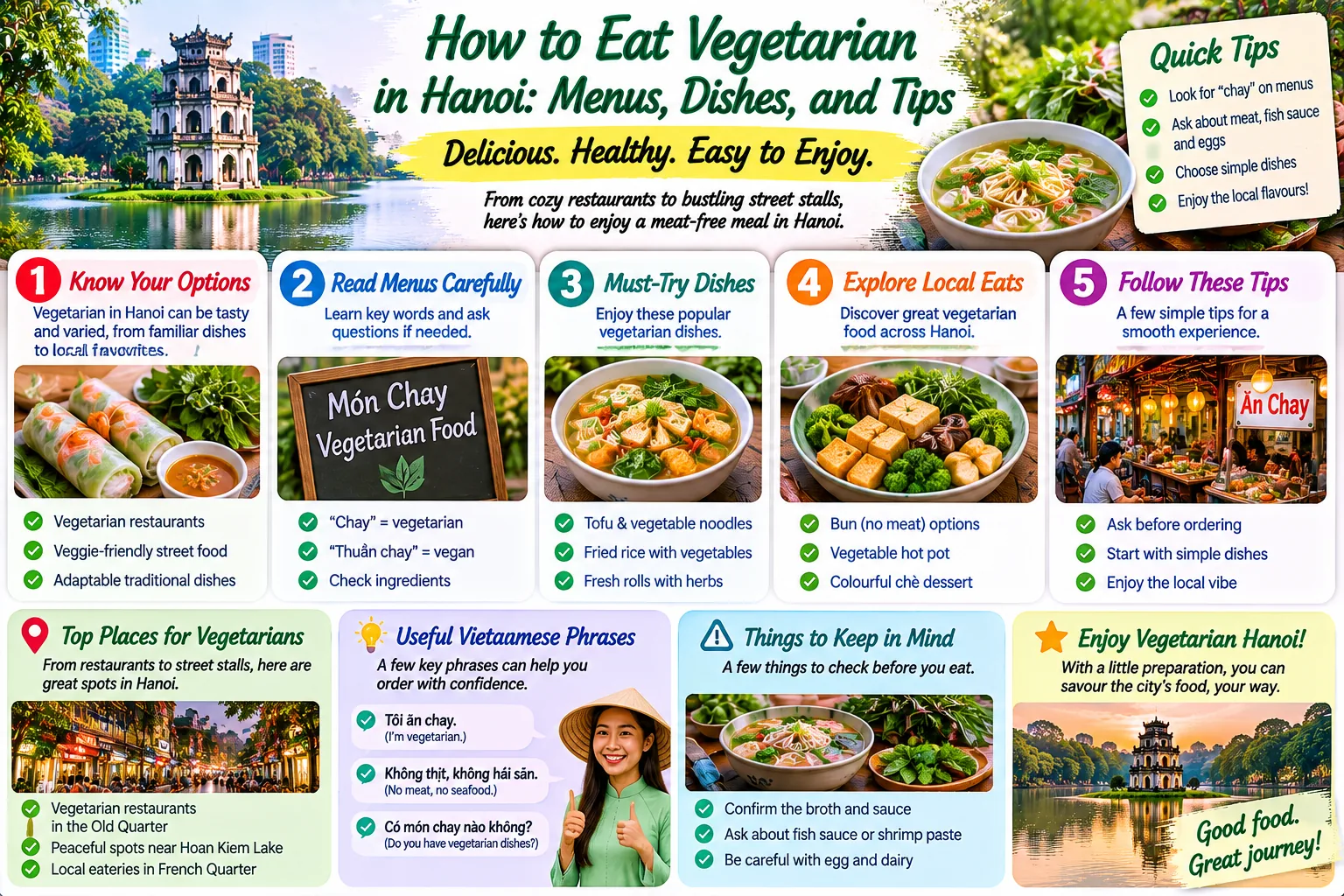
Vietnamese food is built around rice, noodles, fresh herbs, vegetables, fermented seasonings, and contrasting textures, so vegetarian eating can be varied rather than limited to a plate of greens. In Vietnamese, chay means vegetarian and is associated with Buddhist dietary principles. You will see it in dish names such as phở chay, bún chay, or cơm chay. Thuần chay means vegan, a useful term when you want to avoid eggs and dairy as well as meat and seafood.
There is an important practical distinction between a vegetarian dish and a vegan dish. A bowl can be meat-free yet still be seasoned with fish sauce, cooked with an egg, or served with condensed milk. Even a vegetable broth may have been prepared in a shared kitchen. If you are vegetarian by preference, asking whether a dish contains fish sauce may be enough. If you are vegan, allergic, or observing a strict religious diet, explain every ingredient that matters.
For a wider orientation, compare this guide with our thoughtful guide to vegetarian eating in Hanoi, then use the Vegetarian & Special Diets category to keep exploring related ideas.
The Vietnamese phrases that make ordering easier
Short, specific phrases are more useful than a long explanation. Show them on your phone if the conversation is noisy or the menu has no English translation.
- Ăn chay. “I eat vegetarian.” This is the broadest phrase and a good opening.
- Ăn thuần chay. “I eat vegan.” Use this when you avoid all animal products.
- Không thịt, không cá. “No meat, no fish.” It is a clear minimum request.
- Không nước mắm. “No fish sauce.” This matters because nước mắm is a fish-based condiment used in Vietnamese cooking.
- Không trứng, không sữa. “No eggs, no milk.” Add these words for vegan meals.
- Có đậu phụ không? “Do you have tofu?” A simple way to ask for a dependable protein.
- Ít cay, làm ơn. “Less spicy, please.” Useful when a sauce or broth may be hotter than expected.
A polite sentence you can save is: Tôi ăn thuần chay. Xin vui lòng không thịt, cá, nước mắm, trứng và sữa. It means that you eat vegan and would like no meat, fish, fish sauce, eggs, or milk. It does not guarantee that a kitchen can prevent cross-contact, so treat it as a communication aid rather than a medical assurance.
What to look for on a Hanoi menu
Noodle bowls and soups
Start with phở chay, vegetarian pho, or a vegetable-and-tofu noodle bowl if the kitchen offers one. Ask whether the broth is vegetarian, not simply whether the toppings are. Bún chay can be a cool bowl of rice vermicelli with herbs, vegetables, tofu, peanuts, and a dressing; check the dressing because fish sauce may be added at the table or mixed into it. If you are exploring the city’s classic noodle culture, our guide to traditional Vietnamese dishes helps explain how broths, noodles, herbs, and condiments usually work, even when you choose the chay version.
Rice plates, tofu, and mushrooms
Cơm chay usually signals a vegetarian rice meal, often served with several small vegetable, tofu, mushroom, or mock-meat preparations. The exact plate can change from one kitchen to another, which is part of the appeal. Look for braised tofu, stir-fried morning glory, mushrooms, pumpkin, eggplant, steamed vegetables, and pickles. Ask whether mock meat contains dairy or egg if you need vegan food; the word “vegetarian” does not always answer that question.
Snacks, rolls, and sweets
Vegetarian versions of fried rolls, steamed buns, rice cakes, and fresh rolls may be available, but fillings and dipping sauces vary. Ask about shrimp paste, fish sauce, and lard as carefully as you ask about visible meat. For dessert, fruit is the simplest choice. Che, Vietnamese sweet soups, may contain beans, coconut milk, fruit, jellies, or sticky rice, but recipes differ and some toppings can include condensed milk. Ask what is in the bowl before ordering rather than assuming that a coconut-based dessert is vegan.
Where vegetarian eating works best
Dedicated vegetarian restaurants are the easiest setting for a strict diet because the menu and staff are already organized around the same questions. They may use “chay” or “thuần chay” in the name, and many offer a broad selection of noodle bowls, rice plates, hot pots, salads, and soy-based dishes. Use a current restaurant directory such as HappyCow’s Hanoi listings as a starting point, then confirm the venue’s present menu and opening status yourself; restaurant information changes.
Local eateries can also work well, especially at lunchtime when a small rice shop displays several prepared vegetable dishes. Pointing is often effective: identify tofu, mushrooms, greens, rice, and noodles, then repeat “ăn chay” before paying. If there is no clear vegetarian option, do not force the order. A simple fruit breakfast, plain rice with vegetables, or a meal at a dedicated chay restaurant is better than a dish whose seasoning you cannot verify.
Cafés and modern restaurants may be comfortable for vegan travelers because menus are more likely to describe ingredients in English. They are useful for a reset meal after a busy street-food walk, but they are not the only answer. For neighborhood eating etiquette and choosing a table, see our local guide to choosing restaurants in Hanoi.
How to eat vegetarian at markets and on the street
Markets are excellent for observing ingredients, but they require more care than a dedicated restaurant. A stall may sell tofu, vegetables, rice, and noodles alongside meat from the same cooking surface. If shared equipment is a concern, ask whether the item is fried or cooked separately. For a general introduction to navigating busy food areas, start with the Food Markets & Night Markets category and remember that a lively stall is not automatically a vegetarian stall.
Look for foods that are visibly assembled rather than hidden inside a broth: fresh fruit, steamed corn, plain rice, boiled sweet potato, grilled mushrooms, or a vegetable plate. Rice-paper rolls and salads need special attention because the filling may be vegetarian while the dressing is not. Fried snacks can contain meat even when the outside looks like a vegetable fritter. Ask about the filling, the oil, and the dipping sauce separately.
Hanoi’s street-food culture is built on quick service and compact workspaces. Keep your request brief, avoid blocking the queue, and accept that a vendor may say no. That response is useful information. Move to another stall rather than asking someone to improvise a complex allergen-free meal in a crowded kitchen.
A simple daily plan for vegetarian visitors
Breakfast: choose a clear base
Begin with fruit, bread with vegetable fillings, a vegetarian noodle soup, or a rice-based dish from a place that can answer your questions. Coffee is usually easy to adapt, but condensed milk is dairy, so request black coffee or a plant-based alternative only when the café clearly offers one. If you are unsure about the first meal of the day, choose a dedicated vegetarian venue and save street-food experiments for later.
Lunch: make it your reliable meal
Lunch is a good time for cơm chay because several dishes may be available at once and you can build a balanced plate. Aim for rice or noodles, a protein such as tofu or beans, two vegetables, and fruit. Hanoi’s heat, walking, and traffic can make a light meal feel insufficient, so carry water and do not rely only on fried snacks.
Dinner: explore with a backup
For dinner, choose either a dedicated vegetarian restaurant or a neighborhood venue with a clear menu. Keep one backup nearby, especially if you are eating before a tour or travelling with children. The Hanoi Food Guides category can help you fit a dependable meal into a larger itinerary rather than leaving dietary decisions until you are hungry.
Food safety, allergies, and practical boundaries
Dietary preference and allergy safety are not the same thing. If you have a serious allergy, carry a translated card that names the ingredient and explains that even a small amount is unsafe. Ask about sauces, stock, marinades, toppings, shared fryers, and the possibility of cross-contact. Vietnam’s official tourism guidance advises travelers with important medical conditions or allergies to carry a doctor’s letter describing the condition and treatment, and it recommends choosing freshly cooked food and using judgment with street vendors.
For everyone, favor food that is cooked hot and served promptly, wash or peel fruit when practical, and use safe drinking water. Do not interpret a vegetarian label as a promise that every ingredient is prepared separately. A quiet restaurant with time to explain your needs is often a better choice than a rushed stall, even if the stall is famous.
Common mistakes to avoid
- Assuming vegetables mean vegetarian. Greens may be stir-fried with meat, stock, shrimp paste, or fish sauce.
- Ordering “no meat” but not “no fish sauce.” Ask about the seasoning and dipping sauce.
- Confusing “chay” with vegan in every context. Confirm eggs and dairy when you need a fully plant-based meal.
- Relying on one translated sentence. Point to ingredients and repeat the key restriction.
- Trying to repair an unclear order at the table. If the dish arrives with an ingredient you cannot eat, politely send it back or choose another meal.
- Planning every meal around a famous dish. Build a flexible route with one dedicated vegetarian stop and one simple backup.
Enjoy Hanoi without making food feel difficult
The most successful vegetarian meals in Hanoi combine preparation with curiosity. Learn chay and thuần chay, keep the fish-sauce question ready, choose dishes whose ingredients you can see, and give yourself permission to prefer a calm restaurant when you need certainty. Hanoi offers more than substitutions: tofu, mushrooms, herbs, rice, noodles, beans, fruit, and coconut-based sweets can form a genuinely varied food experience. With a few clear boundaries and a little local vocabulary, eating vegetarian becomes a way to notice how the city cooks rather than a reason to sit out its food culture.
JOIN THE CONVERSATION
Comments (0)
No comments yet. Be the first to share a thought.