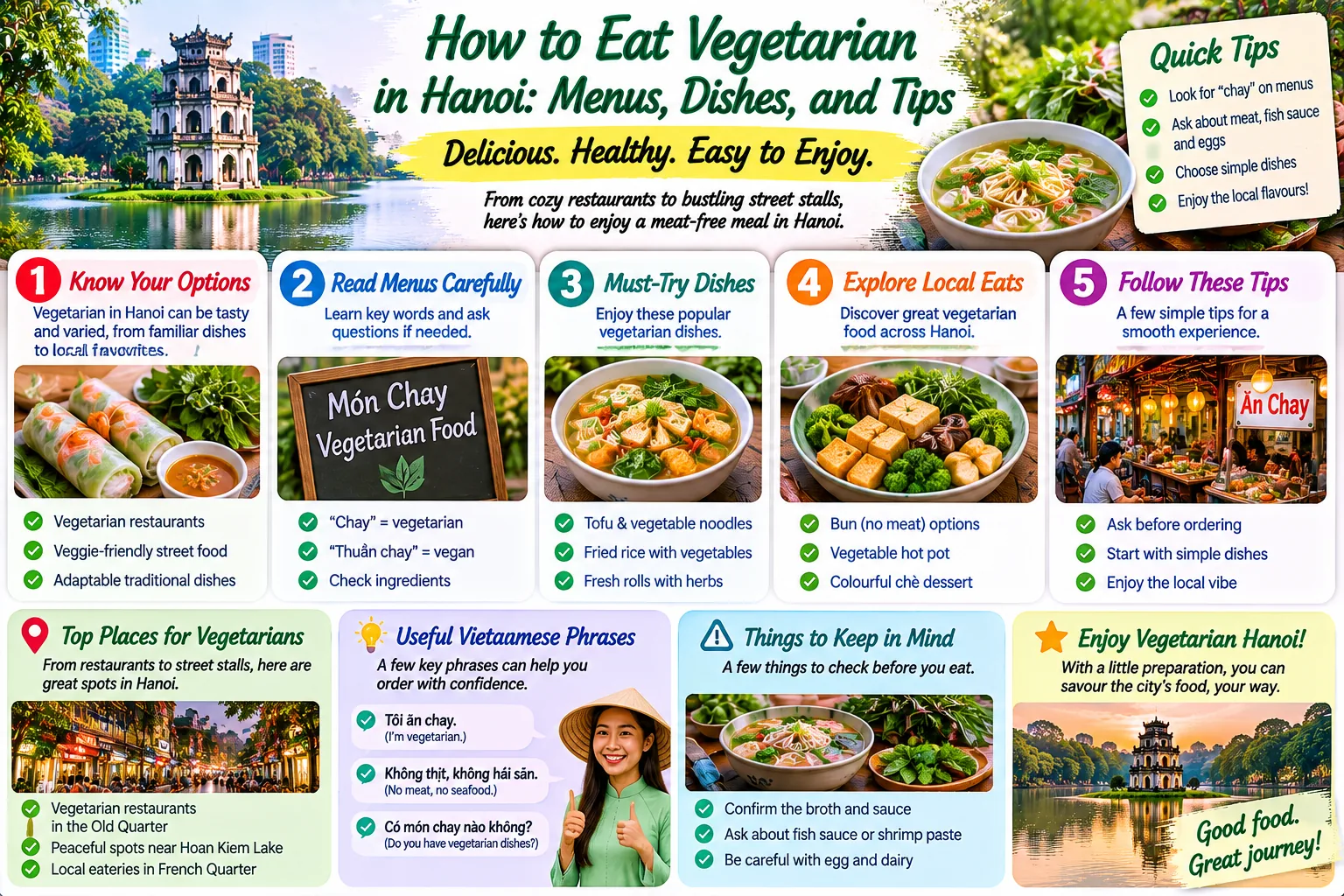
Vegetarian eating in Hanoi is less about finding one perfect restaurant and more about learning how the city’s food is built. A bowl of noodles, a plate of rice, a market snack, or a shared hot pot can all become part of a meat-free day when you know what to ask and how to read a menu. Hanoi’s famous street-food culture is broad, regional, and often built around ingredients that are not vegetarian, so a little preparation makes the experience more relaxed.
Start with the right vegetarian plan for Hanoi
The most useful approach is to decide how strictly you eat before choosing where to go. Vegetarians who eat eggs, dairy, or fish sauce have a different range of options from vegans, and travellers with allergies need a separate conversation with each kitchen. In Hanoi, “vegetarian” should therefore be treated as a clear request rather than an assumption.
If you eat eggs but avoid meat and seafood, say so when ordering. If you are vegan, explain that you also avoid eggs, dairy, fish sauce, shrimp paste, and meat-based stock. This matters because familiar-looking dishes may contain a broth, dipping sauce, or topping that is not visible in the final bowl. For a useful overview of the city’s broader food vocabulary and eating rhythm, read this guide to traditional Vietnamese dishes in Hanoi before you arrive.
Choose convenience or discovery
For the easiest first meal, choose a clearly vegetarian restaurant or a place with a dedicated meat-free menu.
For discovery, explore a market or street-food area with a flexible plan and ask about each dish before ordering.
For a group, select a shared meal where vegetables, tofu, mushrooms, rice, and noodles can be ordered separately.
Do not measure success by how closely a meat-free meal imitates pho or bun cha. Hanoi’s food culture also includes rice, noodles, herbs, vegetables, tofu, beans, sweet soups, and snacks. A good vegetarian day can be varied without reproducing every famous meat dish.
Learn the menu signals that make ordering easier
Menus may use Vietnamese names, English translations, pictures, or a mixture of all three. Pictures help you recognise a dish, but they cannot confirm the stock or sauce. Ask the server to explain the base, toppings, and dipping sauce, especially when a dish is served in several parts.
The word “chay” is the key term to look for on menus and signs. You may also see “thuần chay” used for food presented as fully plant-based. Even then, confirm what the kitchen means, because restaurants can use different levels of detail when describing ingredients. Keep the request short, calm, and specific: no meat, no seafood, no fish sauce, no shrimp paste, and no animal stock if those are your requirements.
For severe allergies, carry a translated card that names the ingredient and the risk. A dish that appears vegetarian can still be unsuitable if it is cooked in a shared broth or finished with a sauce. When communication is uncertain, choose a simpler plate with visible ingredients rather than a complicated mixed bowl.
Questions worth asking
Is the broth made with vegetables, or with meat or bones?
Does the sauce contain fish sauce, shrimp paste, or oyster sauce?
Are the noodles or dumpling wrappers made with egg?
Can the kitchen leave out the meat topping and replace it with tofu or vegetables?
Is the dish cooked separately, or in a shared pan or pot?
For more help with reading local food situations, combine this article with the site’s practical guide to choosing restaurants in Hanoi. The same habits—watching how a place works, asking focused questions, and choosing a busy but manageable setting—are useful for vegetarian diners.
Know which Hanoi dishes can be adapted
Hanoi’s best-known dishes are not automatically vegetarian. The official Vietnam Tourism food guide describes bánh cuốn with fillings such as pork, eggs, or mushrooms and notes that it is served with herbs and a fish-sauce-based accompaniment. That makes it a dish to question carefully, not a dish to order by name alone. A mushroom version may still arrive with a non-vegetarian sauce, so ask about every component.
Rice noodles and glass noodles can be useful starting points because the topping and broth may be changed, but the preparation varies from stall to stall. Ask whether a noodle soup can be made with a vegetable broth, and whether the herbs and vegetables are served separately. Stir-fried noodles may be easier to customise than a long-simmered soup, provided the cooking oil and seasoning are suitable for you.
Hot pot can work well for mixed groups. Vietnam Tourism presents lẩu as a shared bubbling pot with vegetables, meat, and seafood added to taste. The practical lesson for vegetarians is to separate the broth and ingredients from the start. A dedicated vegetable pot is safer than dropping vegetables into a broth already used for meat or seafood.
Reliable categories to explore
Tofu with vegetables or mushrooms, when the sauce is confirmed to be vegetarian.
Rice plates with greens, tofu, peanuts, pickles, and a separate sauce.
Fresh rolls or rice-paper dishes, after checking the filling and dipping sauce.
Vegetable noodle dishes, with egg and stock questions answered first.
Chè, the colourful sweet dessert soup described by Vietnam Tourism with ingredients such as beans, glutinous rice, herbal jelly, syrup, and coconut.
Chè can be a satisfying finish, but it is not automatically vegan: ask about condensed milk, dairy, or other additions. The point is not to memorise a fixed safe-food list. It is to identify a base you understand, then confirm the parts that change from one kitchen to another.
Use Hanoi’s street-food culture without taking unnecessary risks
Street food is part of the city’s character, and Vietnam Tourism describes Hanoi food as something encountered around the city rather than only in formal dining rooms. That openness is useful for vegetarians because you can watch ingredients being assembled and make a quick decision. It can also be challenging because stalls may specialise in one meat-based dish and have little ability to alter it.
Spend a few minutes observing before you sit down. Look at the ingredients in the trays, the pot on the stove, and the sauces on the table. If the main preparation is clearly meat or seafood, asking for a vegetarian substitute may create more confusion than choosing another stall. A vendor who cannot answer your question is not necessarily careless; the dish may simply not be designed to change.
Start with one small order, then decide whether to continue. This is especially useful when you are testing a new place, managing allergies, or travelling with someone who has a strict diet. Keep tissues, hand sanitiser, and water available, and avoid treating every unfamiliar texture or herb as a problem. The practical goal is a comfortable meal, not a perfect performance of local eating.
Markets and food walks
Markets are best approached as ingredient-led experiences. You may find fruit, roasted sweet potatoes, rice cakes, tofu, steamed corn, nuts, or sweet desserts, but availability changes by stall and day. A market visit does not need to be a full meal. Pair a few clearly identified items with a sit-down dish later.
If you enjoy moving between small stops, the site’s practical Hanoi street-food guide can help you think about neighbourhoods, ordering, and pacing. You can also browse the Food Markets & Night Markets category and the Hanoi Food Guides category for more planning ideas. Before joining a food walk, tell the organiser exactly what you avoid and ask whether substitutions are realistic at every stop.
Build a one-day vegetarian food route
A flexible route is easier than trying to find three perfect meals in advance. Begin with a breakfast that has a clearly identified base. Rice porridge, noodles, sticky rice, or a simple rice-and-vegetable plate may work, but confirm stock, toppings, and sauces before ordering. If breakfast is uncertain, fruit and a familiar packaged item can give you time to find a better lunch.
For lunch, choose the meal that deserves the most questions. A restaurant with a dedicated vegetarian menu or staff who can explain ingredients gives you a calmer middle-of-the-day anchor. Order enough variety to understand the kitchen: perhaps tofu, greens, rice, and a noodle or mushroom dish. If you are sharing, keep sauces on the side where possible.
Use the afternoon for a snack or dessert rather than another complicated meal. Chè, fruit, roasted corn, or a rice-based snack may be easier to assess than a dish with a hidden broth. In the evening, a shared hot pot or a simple sit-down meal can work well if the vegetarian portion is kept separate from meat and seafood.
Match the route to your travel style
First-time visitor: choose one clearly vegetarian restaurant, then add one market or street-food stop.
Confident eater: mix a dedicated vegetarian meal with carefully questioned local dishes.
Vegan traveller: prioritise kitchens that can explain stock, sauces, and cooking methods in detail.
Traveller with allergies: use a written explanation, avoid uncertain mixed dishes, and keep a backup meal option.
For a broader day-by-day structure, see the Hanoi food itinerary for first-time eaters. Its value for vegetarian visitors is the pacing: leave room to change plans instead of booking every meal around a single dish.
Make vegetarian dining feel social and local
Dietary care does not have to turn every meal into a negotiation. Start by sharing what you can eat, not only what you cannot. “Vegetables, tofu, rice, mushrooms, and noodles are fine; please no meat, seafood, fish sauce, or shrimp paste” is more useful than a general statement that you are vegetarian.
Be ready for a menu to be narrower than expected. That is not a failure. Hanoi’s classic dishes often depend on meat, fish, or fermented seafood, as the city’s official food guides make clear. A respectful response is to ask what the kitchen can prepare confidently, then choose from those options. You may discover a good vegetable dish that was never marketed as a special dietary item.
Vegetarian eating also fits naturally into the shared-meal tradition when everyone orders thoughtfully. Put a vegetable dish, tofu, rice, and fresh greens in the centre, and let meat-eating companions order their own additions separately. This keeps the meal communal without making one person responsible for adapting every plate.
Common mistakes to avoid
Assuming a dish is vegetarian because it contains vegetables.
Forgetting that dipping sauces and broth count as ingredients.
Ordering a famous Hanoi dish without checking the standard filling.
Expecting every street stall to create a separate meal.
Trying too many unknown dishes at once when you have an allergy.
Using “vegan” without explaining the ingredients you specifically avoid.
One final habit helps most: keep your plan adaptable. Research a few options, save the addresses, and then make decisions based on what you can confirm in person. Hanoi rewards curiosity, but a good vegetarian experience depends just as much on clear questions as on adventurous eating.
Conclusion: eat with curiosity and clear expectations
Vegetarian eating in Hanoi is practical when you treat each meal as a small act of communication. Learn the menu signals, question broth and sauces, choose visible ingredients when uncertain, and leave space for simple dishes that may not appear in a headline food list. With that approach, you can enjoy Hanoi’s street-food energy, shared tables, markets, noodles, tofu, vegetables, and desserts without forcing every meal into a familiar template.
JOIN THE CONVERSATION
Comments (0)
No comments yet. Be the first to share a thought.