Vegetarian food in Hanoi is not a compromise or a narrow side category. It can be a lively tour of herbs, rice noodles, tofu, mushrooms, seasonal vegetables, peanuts, sesame, and the gentle depth of Vietnamese broths. The challenge is knowing what “vegetarian” means in the place you are ordering, how to explain your needs clearly, and when a meat-free-looking dish may still contain fish sauce, shrimp paste, or stock. This guide helps you eat confidently, whether you are fully vegan, vegetarian, pescatarian, gluten-conscious, or simply looking for a few plant-based meals between Hanoi food experiences.
What vegetarian eating in Hanoi really involves
Hanoi’s food culture is built around balance: fresh herbs with salty seasoning, soft noodles with crisp toppings, and cooked dishes alongside raw greens. That balance gives vegetarian diners plenty to explore, but it also means that a dish can contain an animal ingredient without looking obviously meaty. Fish sauce, chicken stock, beef stock, dried shrimp, oyster sauce, and shrimp paste are common sources of confusion.
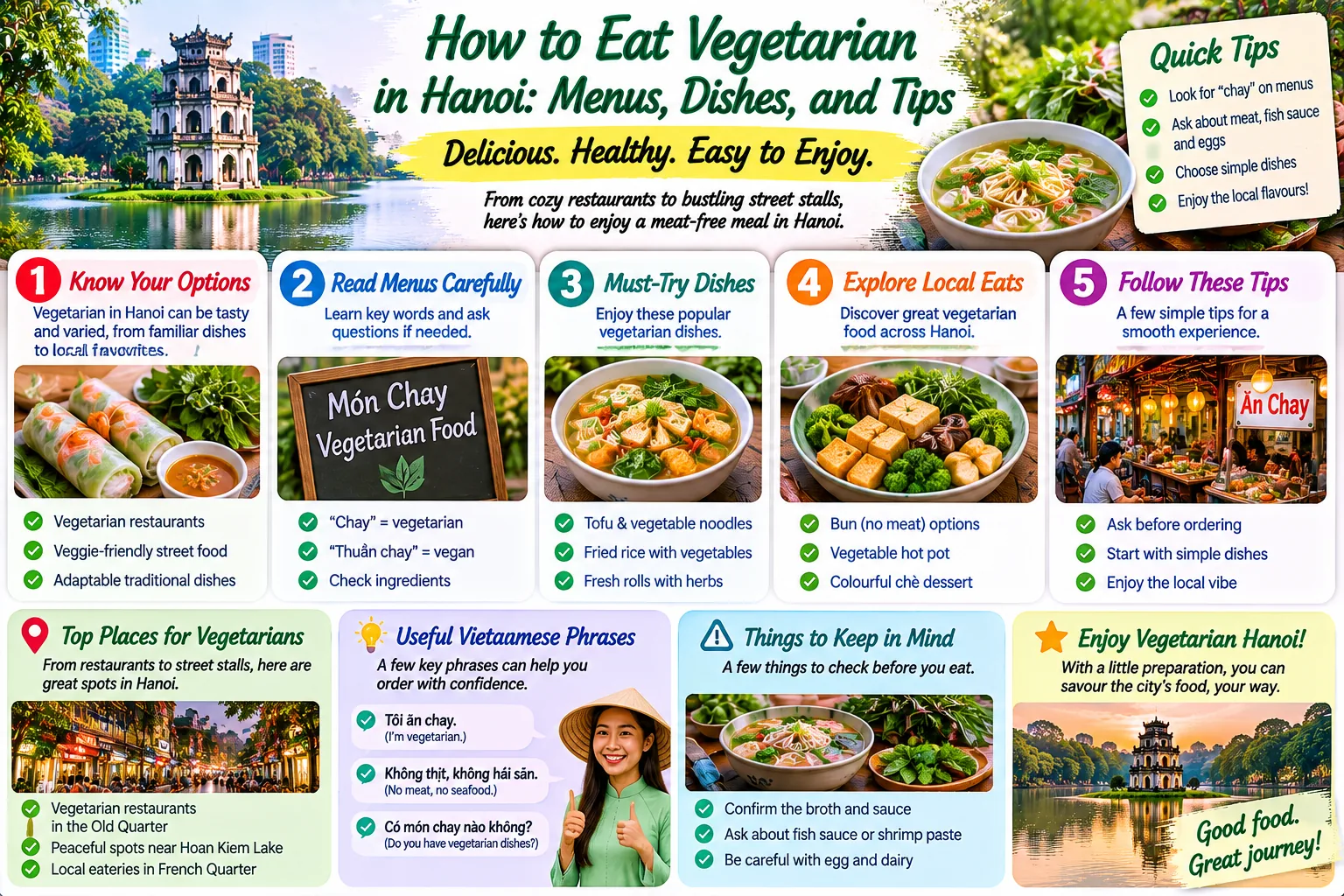
In Vietnamese, “chay” means vegetarian. A restaurant advertising “đồ chay” is presenting meat-free food, while “thuần chay” usually signals vegan food. Still, do not assume that every vegetarian dish is vegan. Some kitchens use eggs, milk, butter, or honey, and some vegetarian restaurants may serve eggs even when their menu is broadly plant-based.
Religious practice is one reason vegetarian food is visible in Hanoi. Some Buddhists eat vegetarian meals on particular days or periods, while others follow a vegetarian diet more consistently. That tradition has helped create an everyday vocabulary of meat-free cooking rather than making it feel like a specialist import. For cultural background, the official Ha Noi destination guide describes the city as a major heritage and gastronomy hub, while the background of Buddhism in Vietnam helps explain why chay food has a familiar place in urban life.
The best vegetarian dishes to look for
Phở chay and noodle soups
Vegetarian phở can be one of the most satisfying meals in the city when the broth is made with roasted onion, ginger, cinnamon, star anise, mushrooms, and vegetables rather than meat. Ask whether the broth is “nước dùng chay” and confirm that it contains no fish sauce. The bowl may come with tofu, mushrooms, greens, fried shallots, herbs, lime, and chilli. It is worth tasting the broth before adding everything on the table: good seasoning should be fragrant rather than simply salty.
Other noodle soups are equally useful. Look for bún, rice vermicelli served with herbs and vegetables, or mì, wheat or egg noodles, if eggs fit your diet. A dry noodle bowl can be easier to customise than soup because the sauce and toppings are more visible. Ask for the sauce separately if you are unsure about its ingredients.
Rice plates, tofu, and vegetables
A vegetarian rice plate may include fried or braised tofu, sautéed morning glory, mushrooms, pickled vegetables, cucumber, greens, and a savoury sauce. Tofu is often prepared in several ways: crisp outside and soft inside, braised with tomato, stuffed with mushrooms, or served in a clay-pot-style dish. Rice plates are practical for travellers because you can point to individual components and ask what contains fish sauce or egg.
Vegetable dishes are not limited to salads. Hanoi kitchens may stir-fry greens with garlic, simmer pumpkin, cook eggplant until silky, or combine mushrooms with pepper and herbs. Because sauces vary, a clear request matters more than memorising a long list of “safe” dishes.
Chả giò chay, bánh, and small bites
Vegetarian spring rolls are often called chả giò chay or nem chay. Their filling may include glass noodles, carrot, cabbage, taro, mushrooms, or tofu. Check the dipping sauce separately: a roll can be vegetarian while the sauce contains fish sauce. Steamed rice cakes, savoury pancakes, and dumpling-style snacks may also be available with mushroom or vegetable fillings, but ask about egg and stock before ordering.
How to order safely: useful Vietnamese phrases
Short, direct language works best. Say “Tôi ăn chay” to mean “I eat vegetarian.” If you are vegan, say “Tôi ăn thuần chay” and then clarify the ingredients you avoid. For a simple question, use “Món này có nước mắm không?” meaning “Does this dish contain fish sauce?” You can also ask “Có thịt không?” for “Does it contain meat?”
- “Không thịt” — no meat.
- “Không cá” — no fish.
- “Không tôm” — no shrimp.
- “Không nước mắm” — no fish sauce.
- “Không trứng” — no egg.
- “Không sữa” — no dairy or milk.
- “Không đậu phộng” — no peanuts.
For a serious allergy, do not rely on the word “chay” alone. Show the Vietnamese phrase written down, point to the ingredient you need to avoid, and ask a companion or hotel host to help explain the risk. Cross-contact is possible in busy kitchens: the same wok, chopping board, fryer, or serving spoon may be used for meat and vegetarian dishes.
It also helps to distinguish preference from medical necessity. “Tôi muốn ăn chay” communicates a choice. If an ingredient could cause a serious reaction, say so clearly and repeat the restriction before the food arrives. A restaurant that cannot answer confidently is not the right place for that meal.
Where to find vegetarian meals in Hanoi
Dedicated vegetarian restaurants
Dedicated chay restaurants are usually the easiest option for vegans and first-time visitors because the menu is designed around meat-free cooking. They may offer Vietnamese comfort food, modern plant-based dishes, buffet service, or mock meats made from tofu, wheat gluten, mushrooms, and soy. Read the menu carefully: “vegetarian” and “vegan” may be separate sections, and egg or dairy can still appear in a vegetarian kitchen.
Use the site’s guide to choosing restaurants in Hanoi for a broader framework: look at the menu, the pace of the room, the clarity of service, and whether the restaurant can answer ingredient questions. A full dining room is not proof of dietary suitability, but a clear menu and staff who repeat your request are encouraging signs.
Neighbourhood eateries and cafés
Small local eateries may have one or two vegetarian dishes rather than a separate menu. Rice, tofu, vegetables, and noodles are often easier to find than a fully vegan set meal. Go at a quieter time if you need a detailed conversation. A café may be useful for breakfast or a light meal, but check whether bread contains milk or egg and whether spreads use fish sauce.
For a wider neighbourhood perspective, browse the site’s Restaurants & Local Eateries category. The most useful approach is not to search for a single “best” address, but to choose a place near your route, inspect the menu in advance, and keep a backup option nearby.
Markets and street food
Markets are excellent for seeing Hanoi’s ingredients, but they require more care for strict diets. Fresh fruit, steamed corn, sweet potatoes, rice cakes, plain rice, and some vegetable snacks may be easier to assess than mixed dishes. Fried food is difficult to verify because oil may be shared. Sauces and seasoning are the main hidden ingredients.
The site’s Food Markets & Night Markets category can help you understand the setting before you go. If you visit a market, arrive with a phrase card, ask one vendor at a time, and choose foods where the ingredients are visible. Do not feel pressured to accept an uncertain dish simply because it looks vegetarian.
A practical vegetarian day in Hanoi
Start with a simple breakfast: vegetarian phở, sticky rice with a clearly meat-free topping, fruit, or bread with vegetables if the bakery can explain the ingredients. Keep the first meal uncomplicated so you can learn how a particular kitchen handles your request.
At lunch, choose a dedicated chay restaurant or a rice plate with tofu and vegetables. This is a good time for a fuller meal because you can ask questions without the pressure of late-night service. Carry your phrase card and confirm the dipping sauce, soup base, and garnish.
In the afternoon, explore the city at a relaxed pace and use snacks strategically. Fresh fruit, tea, coffee without condensed milk, or a clearly labelled sweet can bridge the gap between meals. Hanoi’s coffee culture is a separate subject, and the site’s Hanoi Coffee Culture category is useful if you want to understand local drinks before ordering.
For dinner, decide whether you want a dedicated vegetarian menu or a carefully selected conventional restaurant. If you are travelling with omnivores, a mixed group can often eat comfortably at a restaurant with both chay dishes and traditional meat dishes, provided the kitchen understands your separation requirements. For inspiration on pacing different meals through the city, see the site’s Hanoi food itinerary and adapt it around your dietary needs.
How to handle common dietary situations
Vegan, vegetarian, and pescatarian are not interchangeable
State the exact boundary. A vegetarian may eat eggs and dairy; a vegan avoids animal products; a pescatarian may eat fish but not meat; and some travellers avoid meat while still eating fish sauce. Restaurants cannot infer these differences. Repeat the key restriction when ordering a shared meal, especially if several sauces arrive together.
Gluten-free and nut-free requests
Rice noodles and rice paper are often useful starting points for gluten-free diners, but sauces, fried toppings, mock meats, and soy products need checking. Wheat-based noodles and regular soy sauce may contain gluten. For nut allergies, ask about peanuts, cashews, sesame, and shared cooking oil rather than mentioning only “nuts.” The same dish can be prepared differently from one kitchen to another.
Shared kitchens and cross-contact
A vegetarian restaurant may still use shared equipment, while a conventional restaurant may prepare a perfectly suitable dish in a separate pan if asked. If cross-contact matters medically, ask whether the kitchen can accommodate you before sitting down. When the answer is uncertain, choose a simpler meal or another restaurant. Food safety is more important than completing a particular food checklist.
How to choose a vegetarian food tour or cooking experience
A food tour can be excellent for dietary travellers when the organiser confirms the menu before the booking. Ask how many stops are genuinely vegetarian, whether vegan substitutions are possible, and whether sauces and broths are included in the review. A tour described as “food-focused” is not automatically suitable for a strict diet.
Cooking classes can be even more flexible because you can discuss ingredients before preparation begins. Ask whether the class can replace fish sauce with a vegetarian seasoning, whether the same workstations are used for meat, and whether the instructor can explain local ingredients in English. The site’s Cooking Classes & Workshops category is a useful starting point for comparing the experience rather than choosing by title alone.
Before booking, send a written message with your restrictions. Keep a screenshot of the reply and repeat the request when you arrive. A good host will tell you what can be changed and what cannot; that honesty is more valuable than a vague promise that “everything is fine.”
Final checklist for eating well
- Learn the words chay and thuần chay.
- Ask about fish sauce, shrimp paste, stock, oyster sauce, egg, and dairy.
- Check dipping sauces and garnishes, not only the main dish.
- Explain allergies separately from preferences.
- Choose visible ingredients when ordering at a market.
- Carry one or two backup restaurants or snacks.
- Confirm dietary needs again for tours, classes, and shared meals.
Vegetarian eating in Hanoi becomes much easier when you combine curiosity with precision. Try the dishes that show off herbs, tofu, mushrooms, rice, and seasonal vegetables, but ask direct questions whenever a broth, sauce, or shared fryer is involved. With a few Vietnamese phrases, a flexible route, and realistic expectations about small kitchens, you can enjoy Hanoi’s food culture without losing control of what is on your plate.
JOIN THE CONVERSATION
Comments (0)
No comments yet. Be the first to share a thought.